
Most Tennessee HOA boards don't realize they're legally required to plan for future repairs until they're staring down a $200,000 roof replacement with no money saved. Understanding Tennessee HOA Reserve Study Requirements prevents this crisis—the Tennessee Condominium Act mandates reserve planning for condos, and even single-family HOAs face lender requirements that make reserve studies essential.
Key Takeaways
- Tennessee HOA Reserve Study Requirements mandate reserve studies for condominium associations, requiring boards to plan for major repairs and capital expenses
- The Tennessee Condominium Act requires annual reviews of reserve funding and updated reserve study data
- Single-family HOAs in Tennessee face no statutory requirement for reserve studies, but governing documents or lender requirements may still apply
- A professional reserve study includes both physical analysis and financial analysis, projecting the useful life and estimated cost of major components
- Reserve planning protects property values and reduces the risk of emergency special assessments
- Boards should work with a qualified reserve study professional who conducts an on-site visit and follows Community Associations Institute Reserve Study Standards
What Are Tennessee HOA Reserve Study Requirements?
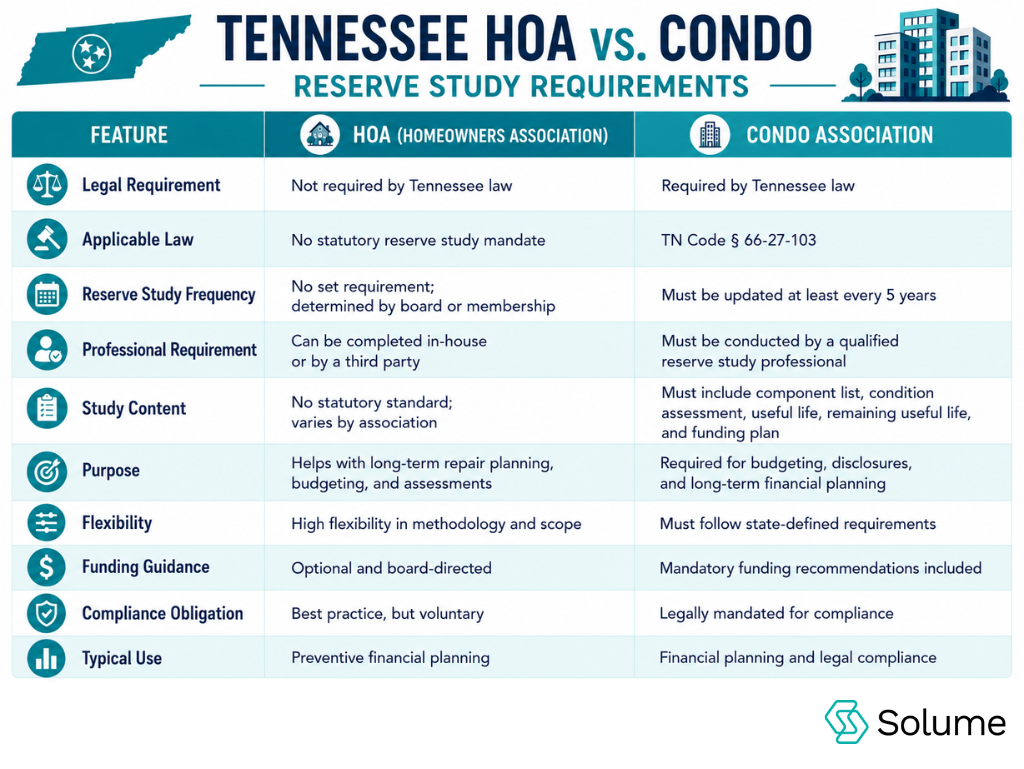
Tennessee HOA Reserve Study Requirements depend on your association type. Condominium associations must comply with the Tennessee Condominium Act, which includes specific reserve account requirements. Single-family HOAs operate under different rules—Tennessee law doesn't mandate reserve studies for planned communities, but your CC&Rs or lender agreements might.
Understanding Reserve Studies
A reserve study is a financial planning tool that identifies major components in your community, estimates their remaining useful life, and projects the cost to repair or replace them. The goal is to fund future repairs without hitting homeowners with surprise bills.
Importance for Homeowners Associations and Condo Associations
Reserve planning separates communities that maintain property values from those that spiral into deferred maintenance. Condo associations face stricter reserve requirements under state law. Homeowners associations may not have a statutory requirement, but lenders like Fannie Mae often require proof of adequate replacement reserves before approving mortgages in your community. Without a current reserve study, buyers can't get financing.
Legal and Regulatory Requirements in Tennessee
Tennessee Condominium Act and State Law
The Tennessee Condominium Act governs all condominium associations in the state. Under Tennessee law, the board of directors must prepare an annual budget that includes reserve contributions for capital expenditures and major repairs. The Act requires the board to maintain replacement reserves unless association members vote to waive funding by majority vote each year.
Reserve account requirements apply specifically to common elements—roofs, building exteriors, fire protection systems, elevators, and shared infrastructure. Single-family HOAs don't face the same statutory requirement under Tennessee State law, though some governing documents impose similar standards.
How New Legislation Impacts Reserve Studies
New legislation in states like Florida and North Carolina has tightened reserve requirements after high-profile building failures. Tennessee hasn't passed similar mandatory reserve study laws for all homeowners associations, but the trend is clear. The Tennessee Condominium Act already requires condominium associations to include reserve funding in the annual budget and disclose reserve balances in the public offering statement.
Key Components of a Reserve Study
A professional reserve study has two parts: physical analysis and financial analysis. Both are necessary.
Physical Analysis
The physical analysis is a detailed inventory of every major component the association is responsible for. A reserve study professional conducts a site visit to inspect common elements, assess their current condition, and estimate remaining useful life.
During the site visit, the reserve specialist documents roofing systems, pavement, building exteriors, fire protection systems, pools, clubhouses, and mechanical systems like HVAC and elevators. The physical analysis determines when each reserve item will need major repairs or replacement.
Financial Analysis
The financial analysis takes the data from the physical analysis and builds a funding plan. It calculates the aggregate replacement cost of all major components, then projects annual reserve contributions needed to cover future repairs.
The financial analysis includes current reserve fund balance, estimated cost for each capital expense, funding requirements based on the useful life of each component, and projected reserve contributions for the next 30 years. Most reserve funding plans aim for 70–100% funded status. Anything below 50% means special assessments are likely.
Best Practices for Reserve Planning and Management
Annual Reviews and Updated Reserve Studies
The Tennessee Condominium Act requires an annual review of reserve funding. Commission a full reserve study with a site visit every 3–5 years, and conduct an annual review in between. The annual review adjusts your funding plan based on inflation, completed projects, and deferred maintenance.
Effective Reserve Fund Management
Reserve funds are not a slush fund. Tennessee law requires condominium associations to segregate reserve contributions from the operating fund. Track reserve contributions as a separate line item in your annual budget, don't mix reserves with the operating fund, update your reserve funding plan after every major repair, and resist the temptation to waive funding.
Boards that waive reserve contributions to keep dues low are trading short-term relief for long-term disaster.
Choosing a Reserve Study Professional in Tennessee
Qualifications to Consider
Look for someone who follows Community Associations Institute Reserve Study Standards and has experience with Tennessee associations.
Ask about credentials, experience with Tennessee communities, and site visit policy. A reserve study professional who skips the site visit is guessing.
The Importance of Site Visits
A site visit is non-negotiable. The reserve study professional needs to see your common elements in person to assess wear, damage, and remaining useful life. A desktop analysis based on photos won't catch hidden issues—like a roof that looks fine from the ground but is failing underneath.
How Reserve Studies Impact Property Values Nationwide
Property values in communities with underfunded reserves drop fast. If your reserve fund balance is too low, Fannie Mae and other lenders may refuse to finance purchases in your community. States with mandatory reserve studies—like Florida, California, and New York—have seen property values stabilize in well-managed communities.
Even in states without a statutory requirement, buyers expect transparency. If your association can't produce a recent reserve study, they'll assume you're hiding deferred maintenance.
Streamlining Reserve Study Management with Solume
Most HOA boards struggle to track reserve contributions and stay compliant with Tennessee law. Without integrated tools, boards lose track of their reserve fund balance and end up scrambling when major expenses arrive.
Solume integrates reserve planning directly into your financial management platform, so you can monitor reserve contributions against your funding plan, track the useful life of major components, and update your reserve funding plan as conditions change—all in one place.
If your board wants a clearer way to manage finances and reserve planning, explore your options with the team to see if Solume fits your community.
Frequently Asked Questions
Are reserve studies required in Tennessee?
Yes, for condominium associations. The Tennessee Condominium Act requires reserve funding and annual budget disclosures. Single-family HOAs don't face a statutory requirement under Tennessee law, but governing documents or lender requirements may still apply.
How often should a reserve study be updated?
A full reserve study with a site visit should be conducted every 3–5 years. An annual review of the financial analysis is required under the Tennessee Condominium Act and recommended for all homeowners associations.
What happens if an HOA doesn't have a reserve study?
Boards risk special assessments, deferred maintenance, and declining property values. Lenders may refuse to finance purchases in your community if you can't prove adequate reserve funding. In condominium associations, failing to comply with Tennessee law exposes the governing body to legal liability.
Can homeowners vote to waive reserve funding?
Under the Tennessee Condominium Act, association members can vote by majority vote to waive or reduce reserve contributions. But that doesn't eliminate the liability—it just delays it. Most financial advisors and reserve specialists recommend against waiving funding.
What's included in a reserve study?
A professional reserve study includes a physical analysis (site visit and inspection of major components) and a financial analysis (projected costs, useful life estimates, and a reserve funding plan). The initial study establishes a baseline; an updated existing reserve study report adjusts for inflation, completed work, and changing conditions.
Is a reserve study worth the cost for a small HOA?
Yes. Small HOAs face the same risk of major repairs—roofs, pavement, and building systems don't care about your community size. Without a reserve study, you're guessing at funding needs. The cost of a reserve study (typically $2,000–$5,000) is far less than the cost of an emergency special assessment when you're caught unprepared. Even if Tennessee law doesn't require it for your single-family HOA, lenders and buyers increasingly expect reserve planning.
How much should an HOA keep in reserves?
Industry standards recommend 70–100% funded status, meaning your current reserve study projects you'll have enough money to cover future repairs without special assessments. Anything below 50% is a red flag.
Can reserve funds be used for operating expenses?
No. Reserve contributions must be kept separate from the operating fund and used only for capital expenses and major repairs. Boards that raid reserves to cover operating budget shortfalls violate the Tennessee Condominium Act and most governing documents.
What is declarant control, and how does it affect reserve studies?
Declarant control refers to the period when the developer still controls the board. During declarant control, the developer may delay reserve funding to keep dues low and attract buyers. Once control transitions to homeowners, the new board often discovers underfunded reserves and deferred maintenance. Tennessee law requires disclosure of reserve balances in the public offering statement, but enforcement during declarant control is inconsistent.
How do condominium budgets address reserve funding?
Condominium budgets must include a dedicated line item for reserve contributions to cover maintenance of common elements. Each board member should review the budget to confirm it includes the amount needed for adequate funding requirements. Unit owners' associations rely on these budgets to avoid special assessments and maintain financial stability.
Tennessee HOA Reserve Study Requirements protect your community from financial crisis. Whether you're a condominium association bound by the Tennessee Condominium Act or a single-family HOA planning proactively, reserve studies are how you avoid special assessments and maintain property values.
This article is for informational purposes and does not constitute legal advice. Boards should consult their attorney for interpretation of Tennessee law and governing documents.