A 40-unit condo association in Florida skipped its reserve study for six years to keep dues flat. When the roof and elevator both failed in the same year, homeowners got hit with a $27,000 special assessment they had two months to pay. That scenario plays out more often than most boards realize, and it's almost always preventable. Solid property management best practices aren't complicated. A self-managed HOA just tends to learn them the hard way. This guide walks through the financial, maintenance, communication, and compliance fundamentals that keep a community stable, as well as reserve planning that protects it from surprises.
Key Takeaways
- Property management best practices come down to five fundamentals: thorough screening, proactive maintenance, clear agreements, consistent communication, and transparent financial tracking.
- Deferred maintenance and underfunded reserves are the risks most boards overlook, and both lead directly to costly special assessments.
- Consistent, documented processes keep a community stable even when volunteer board members change every year.
- Transparency in financial reporting is what builds trust between boards and homeowners and reduces disputes.
- Self-managed communities in compliance-focused states like Florida and California face stricter legal requirements, making reserve planning and accurate records a fiduciary necessity.
Financial management, bookkeeping, and reporting fundamentals
Here's the hard truth: most disputes between boards and homeowners start with money nobody can account for. Good financial management for a self-managed HOA begins with a clean operating account and a separate reserve account, never commingled. Record every dollar in and out the same way, month after month. That's how you keep audit-ready books when an owner or a state auditor asks. Purpose-built financial management tools built for volunteer boards make that consistency far easier to maintain.
Budgeting and reporting are where board responsibility gets real. A monthly or quarterly financial statement, shared openly with owners, is the fastest way to build financial transparency. When homeowners can see where dues go, they stop assuming the worst. If you're building your first annual plan from scratch, a step-by-step HOA budget template provides a reliable starting point.
Here's why this matters: fiduciary duty isn't satisfied by good intentions. It's satisfied by records, because a board that can't document a decision can't defend it if an owner challenges it. Tax handling matters too, and reviewing the IRS Form 1120-H instructions for homeowners associations helps boards understand filing requirements and avoid penalties. Most boards assume dues collection is the hard part. In reality, the harder job is reporting those funds clearly enough that nobody has to guess.
Property maintenance and preventive/predictive planning
Deferred maintenance is the most expensive habit a board can develop, and it hides well. A small roof leak becomes a structural repair. A neglected drainage issue can lead to foundation damage. Small problems compound quietly because water and wear don't stop between board meetings, then arrive as emergencies with five-figure price tags.
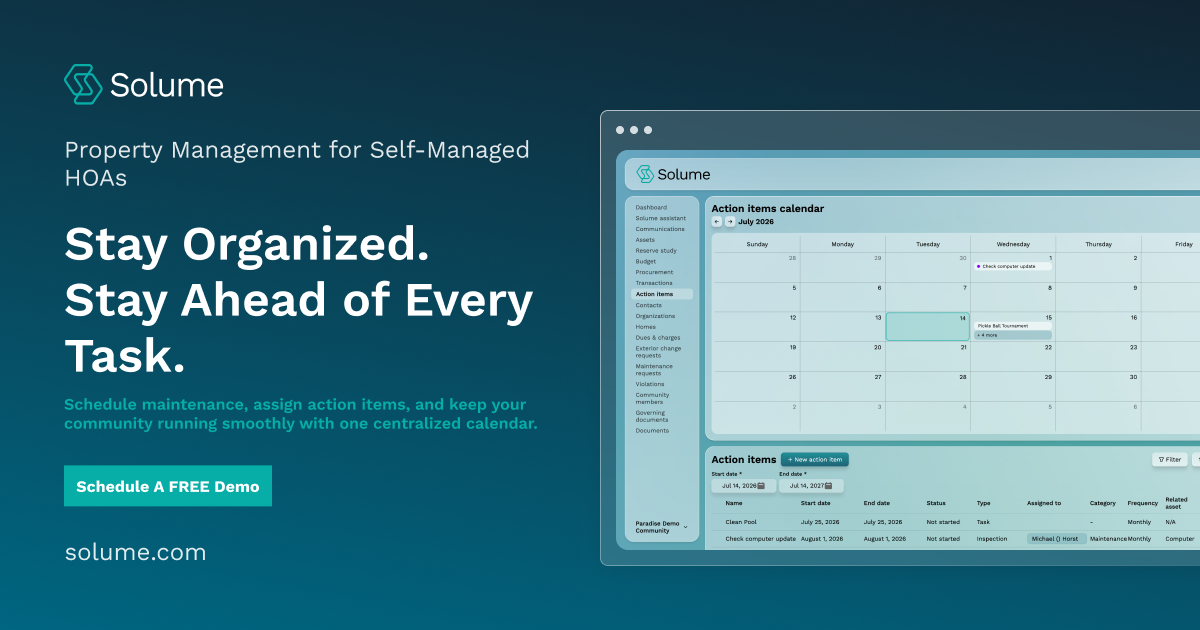
Preventive maintenance flips that pattern. Schedule inspections on a calendar, not on complaints. Roofs, HVAC, elevators, plumbing, and paint all have predictable lifespans. Tracking them lets you budget repairs before they fail. Predictive maintenance goes further by using service history and equipment age to flag what's likely to fail next. You replace on your timeline instead of a crisis timeline. Newer communities can reference U.S. new-residential construction characteristics to understand the materials and components they'll eventually need to plan for.
The U.S. Federal Emergency Management Agency publishes guidance on structural risk management that reinforces the same point: routine assessment reduces the chance of catastrophic cost. For self-managed communities, a maintenance log tied to each building component is a practical tool. It turns property maintenance from reactive to planned. Tracking requests in one place also stops small items from slipping through the cracks between board meetings.

Property management software and technology systems
Most self-managed HOAs run on a patchwork: one spreadsheet for dues, an email inbox for complaints, a filing cabinet for governing documents, and a treasurer's memory for everything else. That works until the treasurer moves away. Then the institutional knowledge walks out the door.
Property management software helps with that by putting records, finances, and communication in one place that survives board turnover. Good property management software handles dues collection, tracks maintenance requests, stores member and home records, and generates the financial reports owners want to see. The right software also reduces human error, which matters when volunteers do this at night after their real jobs.
Here's a difference worth naming. Legacy HOA software was built for professional property management companies, not for volunteer boards. Solume was built specifically for self-managed communities, with financial tools, dues collection, and a centralized communication hub aimed at boards without accounting staff. If you're comparing options, our breakdown of the best HOA management software for self-managed boards is a good place to start. When you pick technology, ask whether it assumes you have a management company. If it does, it wasn't built for you.
Communication and resident/tenant relations
Poor communication doesn't just annoy people. It erodes trust, and lost trust shows up at the next election as an angry vote. Consistent resident communication is one of the cheapest management strategies with the highest return. It helps every community association reduce avoidable friction.
Pick a channel and use it reliably. A resident portal, backed by email and text, beats scattered flyers and hallway conversations. When a homeowner submits a maintenance request, acknowledge it fast, even if the fix takes longer. Silence reads as neglect.
Transparency belongs in communication too. Share meeting minutes, budgets, and major decisions before owners have to ask. What many communities don't realize is that most conflict comes from surprise, not disagreement. People tend to accept hard news like a dues increase far better when they saw it coming and understood why. For communities with rentals, it also helps to point residents to external consumer financial protection resources so they understand their obligations.
A centralized communication hub keeps every notice, request, and response in one trackable place. That helps protect the board if a resident later claims they were never told. For communities with rentals, the same responsiveness supports tenant satisfaction and helps keep units occupied.

Vendor and service provider management
The wrong vendor relationship can quietly drain a budget for years. A landscaping contract that auto-renews at a higher rate, a plumber who overcharges because nobody compared bids, a roofer chosen off one call: these add up. Vendor management is where financial responsibility meets daily operations. If your board is weighing outside help, know the red flags to watch for with management companies before signing anything.
Build a simple system. Keep at least two or three bids on file for any significant job. Store contracts, insurance certificates, and warranty documents where the next board can find them. Track vendor performance so you know who showed up on time and who didn't. A dedicated tool for organizing vendor bids and maintenance requests keeps all of that in one place instead of scattered across inboxes.
The root cause of most vendor problems is missing records, not bad vendors. When HOA board members can't remember what was agreed to or what was paid, accountability disappears. Solume's vendor management and reference tools help boards keep bids, contracts, and service history organized in one place, so vendor decisions survive turnover. Good vendor management also feeds your maintenance planning, because a documented service history is exactly what predictive maintenance depends on.
Reserve study integration and long-term capital planning for self-managed HOAs
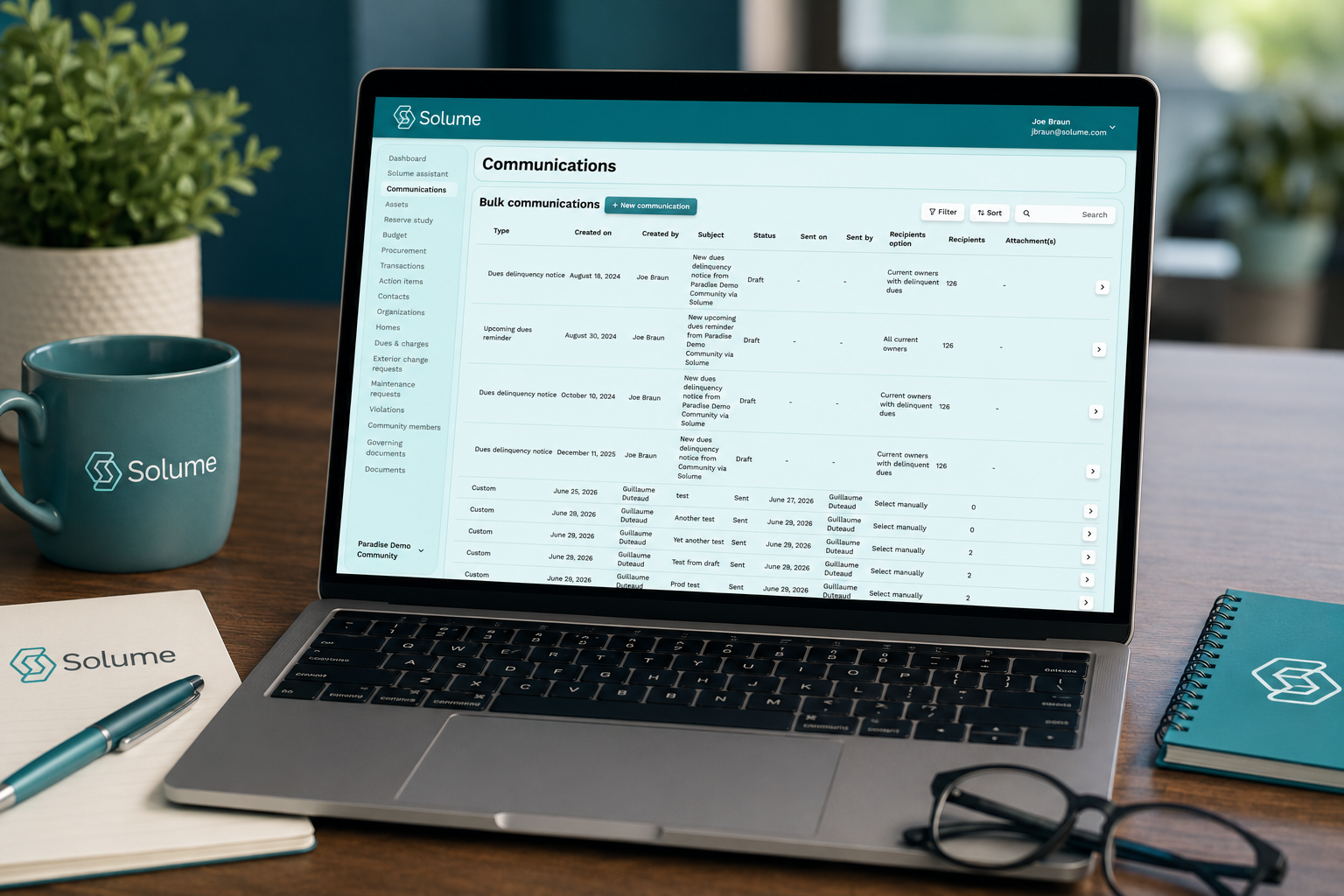
A reserve study is a forecast: what major components will need replacing, when, and how much they'll cost. Most self-managed HOAs either skip it or file it away and never fund it. Both mistakes end the same way, with a special assessment nobody budgeted for. Using dedicated reserve study and long-term capital planning tool helps boards keep the forecast current rather than letting it gather dust.
Long-term planning means treating the reserve study as a living document, not a shelf ornament. It should drive your reserve funding contributions every year, adjusted as components age and prices rise. Capital planning at this level is what tends to separate communities that glide through a roof replacement from communities that panic through one.
States are tightening the rules. Florida's structural integrity reserve study requirements and reserve mandates under state laws in California, Nevada, and Colorado now make reserve planning a matter of legal compliance, not just a financial one. Florida boards in particular should review the Florida Condominium Act (Chapter 718) to understand exactly what's required. Reserve requirements vary significantly by state, so confirm your obligations with your state's HOA statute or your association attorney. Solume includes automated reserve study tools and compliance tracking. These help boards without financial backgrounds tie their reserve study directly to annual budgeting and reporting.
Preventing special assessments through proactive funding and financial transparency
Special assessments are often a symptom, not an accident. The symptom is frequently chronic underfunding that finally hit a wall. When a board keeps dues artificially low to stay popular, it borrows against the future, and the future eventually sends the bill.
Proactive funding is the cure. Fund the reserve to the level your reserve study recommends, even when it means a modest dues increase. Small, predictable increases are generally far easier for homeowners to absorb than a sudden $20,000 demand. The math is simple, but the discipline is hard for a volunteer community association board that faces its neighbors at the mailbox.
Financial transparency is what makes this politically survivable. When owners can see the reserve balance, the funding plan, and the reasoning behind a dues increase, resistance tends to drop. The risk most boards overlook is that hidden financial decisions breed suspicion, and suspicion makes every funding vote a fight. Applying these property management best practices consistently, year over year, is how communities work to avoid the assessment trap and protect stability.
Reducing volunteer board burnout with automation and clear responsibilities
Board burnout is real, and it's a management risk, not just a morale problem. When a treasurer quits mid-year because the workload is crushing, financial continuity breaks. Vacancies pile responsibilities onto whoever's left, and quality drops.
Two things help reduce board burnout. First, clear roles. Write down who owns dues collection, who handles vendor calls, and who prepares the financial report. Ambiguity is what makes volunteers feel like everything is their problem. Second, automation. Automated dues collection, late notices, and maintenance request routing take the repetitive workload off human volunteers.
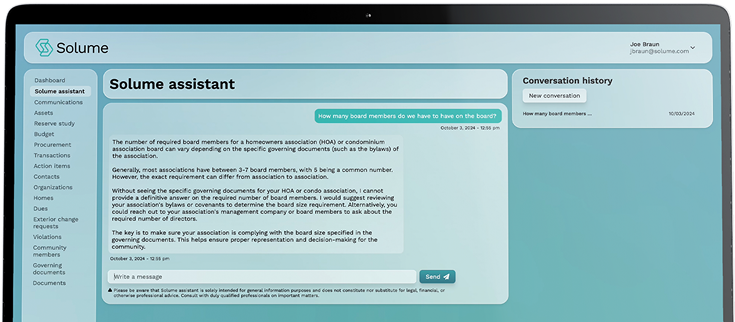
Automated support also helps protect the community when HOA board members change. Solume's AI Assistant offers boards 24/7 help understanding governing documents and compliance requirements, so a new treasurer isn't starting from zero. The goal isn't to replace the board. It's to shrink the grind so good people stay. A volunteer board that isn't drowning makes better long-term planning decisions, and better decisions are the whole point of property management best practices.
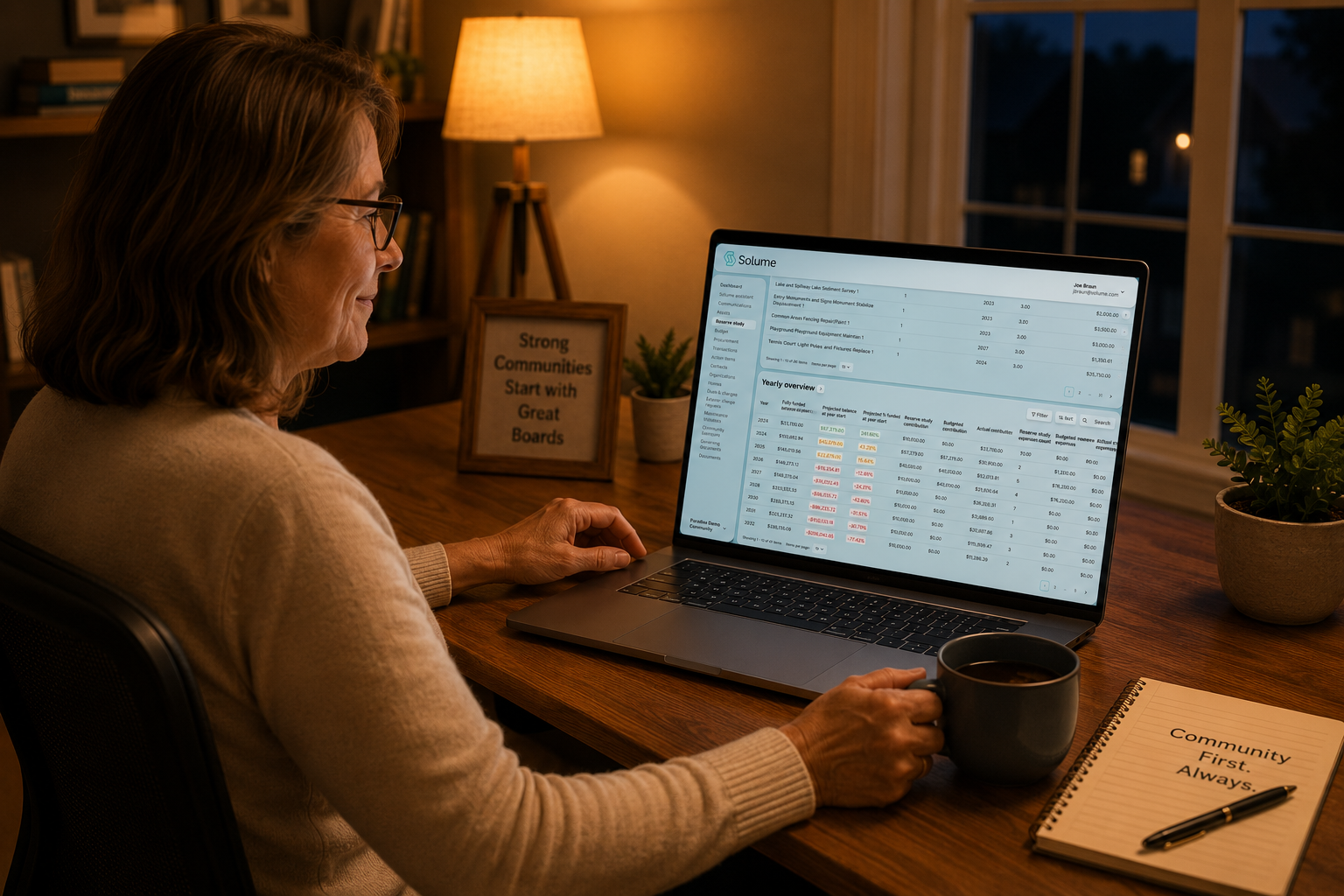
If your board wants a clearer way to manage finances, reserve planning, and vendor oversight without a traditional management company, you can book a 15-minute fit call to see whether Solume matches how your community actually operates. No pressure, just a straight look at whether the tools solve the problems you're facing.
Frequently Asked Questions
What are the best practices in property management?
Core best practices include thorough tenant or resident screening, proactive maintenance to prevent deferred repairs, clear written agreements, consistent communication, and transparent financial tracking. For HOA and condo boards specifically, this also means reserve planning and staying current with state compliance requirements.
What are the 5 P's of property management?
The 5 P's are commonly described as People, Property, Processes, Promotion, and Profit. For self-managed communities, the most overlooked of these is Processes: consistent, repeatable systems for dues collection, maintenance requests, and financial reporting that don't fall apart when a volunteer board turns over.
What is the 80/20 rule for rental property?
The 80/20 rule suggests that roughly 80% of your results (income, headaches, or repair costs) come from about 20% of your causes. In community management, this often means a small share of deferred maintenance items or delinquent accounts drives the majority of financial risk, so identifying that critical 20% early protects long-term stability.
How can boards improve tenant or resident retention and satisfaction?
Respond to maintenance requests quickly, ideally within 24-48 hours for non-emergencies, and keep residents informed through consistent channels like portals, email, and text. Transparency about finances and decisions builds the trust that keeps people engaged and reduces conflict.
What separates good property management from poor management?
The clearest difference is communication and transparency: good management responds promptly and shares financial information openly, while poor management delays responses and leaves owners guessing. Strong screening, documented processes, and proactive maintenance separate stable communities from ones lurching between crises.
Is investing in property management software actually worth it for a small self-managed community?
For boards still running on spreadsheets and email, software pays off by centralizing dues collection, maintenance tracking, and financial reporting in one place, reducing errors and volunteer burnout.
What if our volunteer board has no accounting or legal expertise?
Most volunteer board members aren't professionals, which is exactly why documented processes and clear tools matter more, not less. Software with built-in financial tracking, reserve study support, and a compliance assistant helps non-experts meet fiduciary duties without hiring a traditional management company.
Why are property management best practices important for a board's fiduciary duty?
Best practices directly protect a community's finances and legal standing: proactive maintenance preserves property values, reserve planning prevents surprise special assessments, and transparent records reduce the risk of fraud. In stricter states like Florida and California, following these practices is increasingly a compliance requirement rather than just good advice.