
A board in a 120-unit condo association once passed a "balanced" budget for three consecutive years. Reserves looked fine on paper. Then the flat roof failed in a February storm. The physical component that nobody had inspected in a decade forced a $340,000 special assessment, split among owners with no warning. That gap between what the books said and what the buildings actually needed is exactly what physical vs financial analysis is built to catch. This article breaks down how each analysis works, where each one fails, and why treating them as separate tasks quietly puts your community at risk.
Key Takeaways
- In physical vs financial analysis, physical analysis assesses the condition and remaining life of tangible assets, while financial analysis evaluates funding, financial statements, and cash flow.
- A reserve study depends on both: a physical component inventory identifies what needs replacing, and financial analysis determines how much to set aside.
- Relying on finances alone can mask deferred maintenance until a component fails, forcing an emergency special assessment.
- Physical inspections carry the most weight for real assets like roofs, elevators, and pavement, where age and wear aren't visible on a balance sheet.
- Self-managed boards don't need to be accountants or engineers to combine both analyses when they use structured reserve and financial tools.
Defining physical analysis vs financial analysis
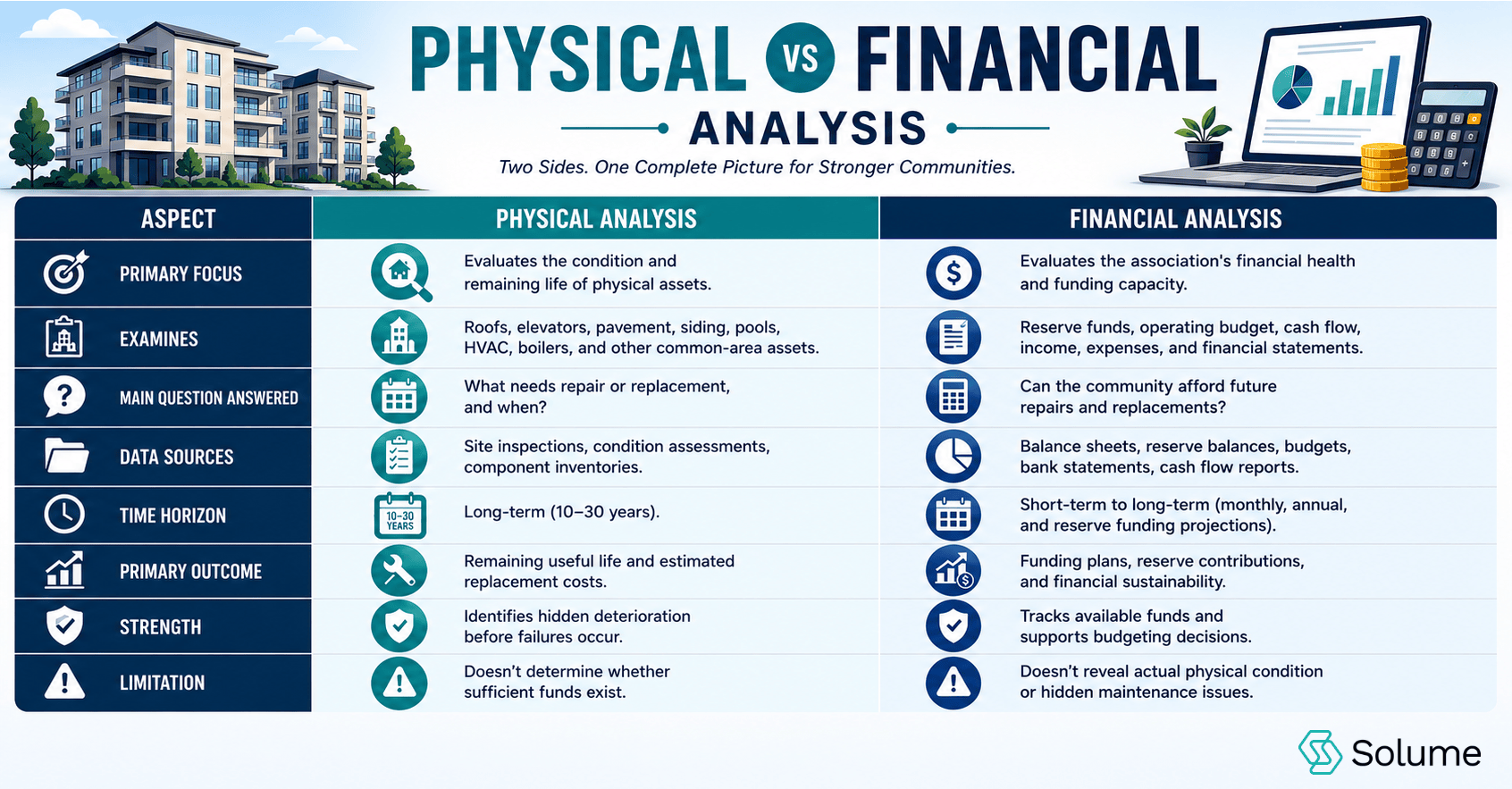
Start with what each one actually measures. Physical analysis examines the actual condition of your community's assets: the age, wear, and remaining useful life of roofs, elevators, siding, pavement, boilers, and pools. It answers a blunt question. What do we own, and how much life is left in it? Financial analysis looks at money: your operating budget, reserve balances, cash flow, dues income, and expense trends. It answers a different question. Can we pay for what's coming?
Most boards are comfortable with one and nervous about the other. Treasurers can read a bank statement. Fewer can tell you whether the parking lot has five years left or fifteen. That imbalance is the root of a lot of trouble. Financial analysis alone gives you a clean-looking number that has nothing behind it. Sound bookkeeping practices for small HOAs matter, but they only cover one side of the picture.
The two disciplines meet directly inside a reserve study. The industry standard already treats these as two required halves of a single process, not as competing methods.
Here's the practical difference. Physical analysis deals in tangible assets and their physical condition assessment. Financial analysis deals in financial instruments, statements, and reserve funding schedules. Physical flows tell you when components will fail. Financial flows tell you whether the money will be there when they do. A self-managed HOA board that understands both to stop guessing and to start planning. Some states require reserve studies with a physical inspection, so check your state's HOA statute and consult a qualified professional to confirm what applies to your community.

The core distinction between tangible assets and financial representations
Tangible assets are things you can touch, and they wear out on their own schedule, regardless of what your books say. A roof doesn't care about your fund balance. It ages, it leaks, and it fails on a timeline set by weather and materials, not by accounting. That's the core distinction: physical reality moves independently of financial representation.
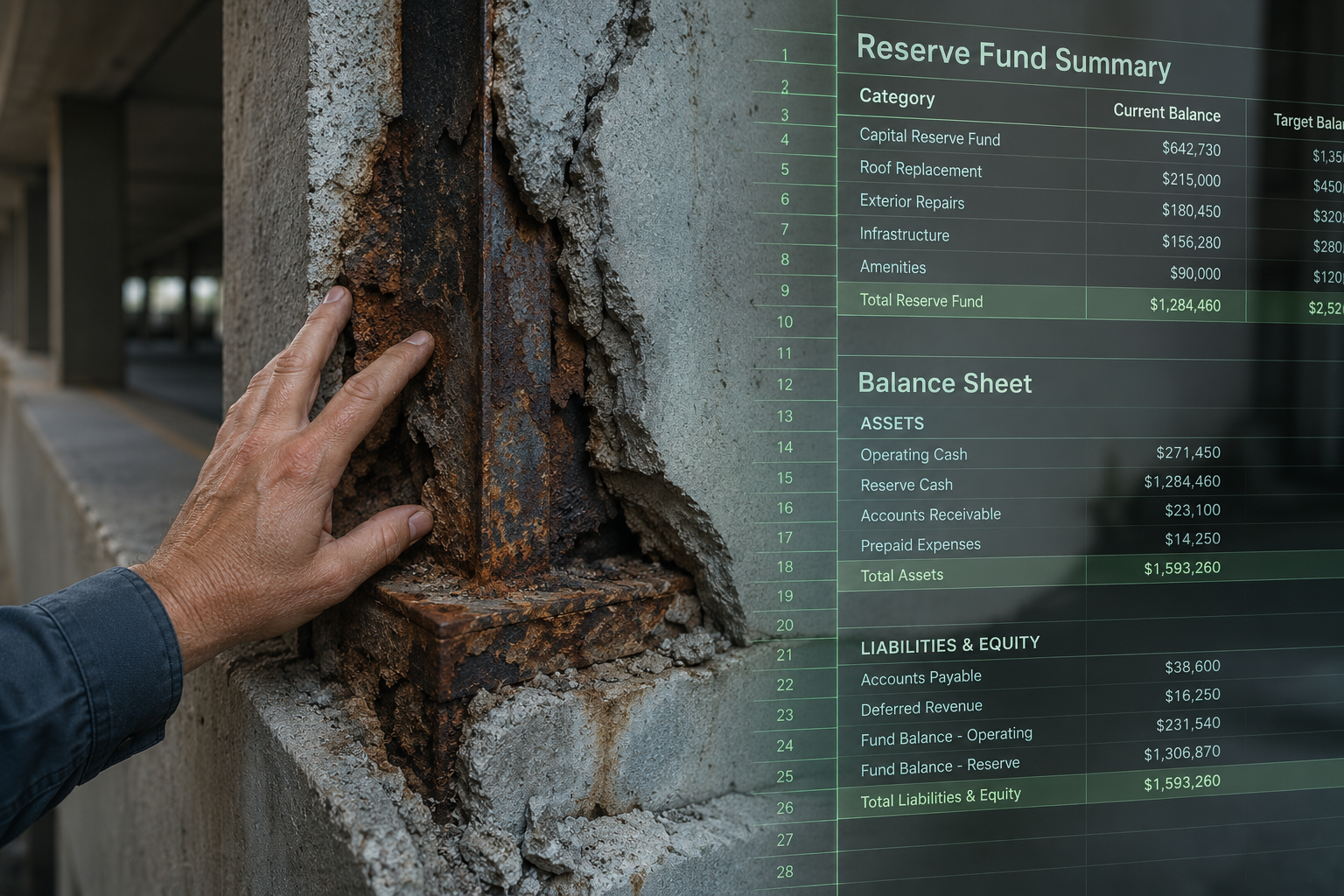
Financial representations are the numbers that stand in for those assets and obligations. Your balance sheet might show a healthy reserve balance and a paid-off loan. But a balance sheet cannot account for the elevator cab being 28 years old and out of manufacturer support. This is where many boards get burned. They assume the financial statement is the whole picture. In reality, the statement is a snapshot of money, not a report card on your buildings.
The reason this matters comes down to timing. Financial instruments and cash reserves are liquid and change month to month. Tangible assets deteriorate slowly and then fail suddenly. By the time a physical problem shows up in your finances, it's already an emergency expense, not a planned one. That lag is the entire argument for a physical component inspection.
Consider the 2021 collapse of the Champlain Towers South condominium in Surfside, Florida, which the National Institute of Standards and Technology is investigating. It's the harshest version of this lesson. Financial records existed. The physical deterioration of the structure was documented but not funded in time. Money on paper did not stop concrete from failing.
For a board practicing physical vs financial analysis, the takeaway is direct. Track your financial flows carefully, but never let them substitute for looking at the actual buildings. The intrinsic value of your community lies in its physical assets, and only a physical assessment can reveal their true state.
Why the two analyses must be integrated rather than treated separately
Run them separately, and each becomes misleading. A physical analysis without financial context tells you the boiler needs replacing, but not whether you can afford it or how it fits into the funding plan. A financial analysis with no physical grounding tells you the reserve balance is $600,000 without asking whether $600,000 is close to enough. Both are true, and both are useless alone.
An integrated approach connects the two so one informs the other. The physical component inspection produces a list of components, their remaining useful life, and their replacement cost. That list feeds directly into the financial analysis, which spreads those future costs across a funding schedule so contributions match real liabilities. This is the mechanism behind every credible reserve study: physical inputs, financial math, one output.
What actually happens when boards keep them apart is a slow drift into underfunding. The budget stays balanced year to year because nobody prices the roof until it leaks. Deferred maintenance accumulates silently. Then, if a single component fails, the gap between what you saved and what you owe becomes a special assessment. Working from a step-by-step HOA budget template that accounts for reserve contributions helps keep that drift from starting in the first place.
Long-term planning only works when both analyses run together. Short-term cash flow is easy to manage month to month. But capital planning over a 20- or 30-year horizon requires knowing both the physical and financial timelines. An integrated approach turns the supply and demand fundamentals of your reserve- what components will demand and what dues can supply- into a plan instead of a hope.
Many assume that a strong reserve balance means the community is safe. In reality, a strong balance measured against an unexamined physical inventory tells you nothing. The two analyses have to be reconciled, or the number is just decoration.
Compare and contrast: strengths and blind spots of each method
Each method is strong exactly where the other is blind. Financial analysis is precise, repeatable, and current. You can pull a report today and know your cash position to the dollar. Its blind spot is the physical world: it cannot detect wear, corrosion, or obsolescence. A financial statement will show a component as a line item long after that component has effectively failed.
Physical analysis is strong on reality and weak on money. A physical condition assessment tells you the true state of your tangible assets: what's cracking, rusting, or nearing the end of life. Its blind spot is affordability and cash timing. An inspector can tell you the pavement needs resurfacing in three years. But they can't tell you whether your reserve funding schedule supports it or whether market dynamics have driven replacement costs up by 20%.
Here are the key differences in plain terms. Financial analysis measures liquidity, income, and expense trends across financial flows. Physical analysis measures condition, age, and remaining life across physical flows. One deals in financial instruments and statements, the other in concrete, steel, and shingles. Neither is the "better" method. They answer different questions.
The blind spots also differ in danger. A financial error usually shows up fast, in a bank reconciliation or a missed dues payment. A physical blind spot hides for years and then arrives as a five- or six-figure surprise. That asymmetry is why boards that only do financial analysis feel safe right up until they aren't. Some of the red flags boards often miss show up precisely in this blind zone between the books and the buildings.
Sound decision-making requires holding both views at once. Use financial analysis to check whether the plan is affordable. Use physical analysis to check whether the plan reflects reality. The strengths of one cover the blind spots of the other, which is the whole point of running them together.

How the two analyses drive different decisions and time horizons
The analyses point to different decisions on different clocks. Financial analysis mostly drives short-term movements: this quarter's cash flow, whether to approve a vendor bid, how much dues income covers monthly operating costs. These decisions live in the operating budget and change constantly.
Physical analysis drives long-term planning. When you know the roof has eight years left, and the elevator has four, you're making decisions on a multi-year and multi-decade horizon. Capital planning is inherently a long-term exercise because tangible assets fail on long timelines. You can't manage a 25-year component with a 12-month view.
The mistake is applying the wrong time horizon to the wrong decision. Boards that manage reserves like an operating budget, quarter by quarter, chronically underfund. The biggest expenses span multiple fiscal years. Long-term planning demands you look past the current cash position to the physical realities arriving in year seven or fifteen.
There's a fiduciary dimension here too. Board members generally carry a fiduciary duty to protect the community's assets and finances, which means both analyses, not just the comfortable one. That fiduciary duty is only half met when a treasurer tracks cash flawlessly but ignores physical condition. Financial responsibility includes funding the future, not just balancing the present.
Community stability depends on getting the time horizons right. Communities that plan physical replacements over the correct multi-decade window fund them gradually and quietly, protecting long-term community stability. Communities that only watch short-term movements fund them all at once, through special assessments that hit owners hard and damage trust. The decision-making improves the moment you match each analysis to its proper horizon: finances for the near term, physical condition for the long haul.
The gap boards miss: reconciling physical condition with reserve funding
The gap is simple to describe and easy to fall into. Physical condition and reserve funding are tracked in different places, by different people, at different times, and nobody reconciles them. The inspector's report sits in a drawer. The treasurer's spreadsheet lives on a laptop. The two never meet, so the funding plan drifts away from the buildings it's supposed to fund.
Reconciling them means one thing: every dollar in your reserve funding plan should trace back to a physical component with a documented condition and remaining life. If your reserve study says you're 70% funded, that number should reflect the actual physical component inspection, not last year's assumptions carried forward.
This is where deferred maintenance does its quiet damage. A board defers a repair to protect this year's budget, which feels responsible in the moment. But deferred maintenance doesn't disappear. It compounds, and the physical condition worsens faster than the reserve grows. The reserve study, built on outdated physical data, understates the real liability, and the community drifts toward a special assessment nobody sees coming.
Self-managed communities are especially exposed here. Volunteer members rotate, records scatter, and institutional memory walks out the door with each departing treasurer. Financial transparency breaks down when physical and financial records don't align, and homeowners lose trust in numbers they can't verify.
Closing the gap requires linking the physical component inventory to the funding plan and keeping both up to date. Solume's automated reserve study tool links the physical condition of components directly to reserve funding calculations, so an HOA board can see how deferred maintenance and aging assets change the required contribution. That connection is what turns a static report into a working funding plan.
Physical vs financial reserve study components and how to read them
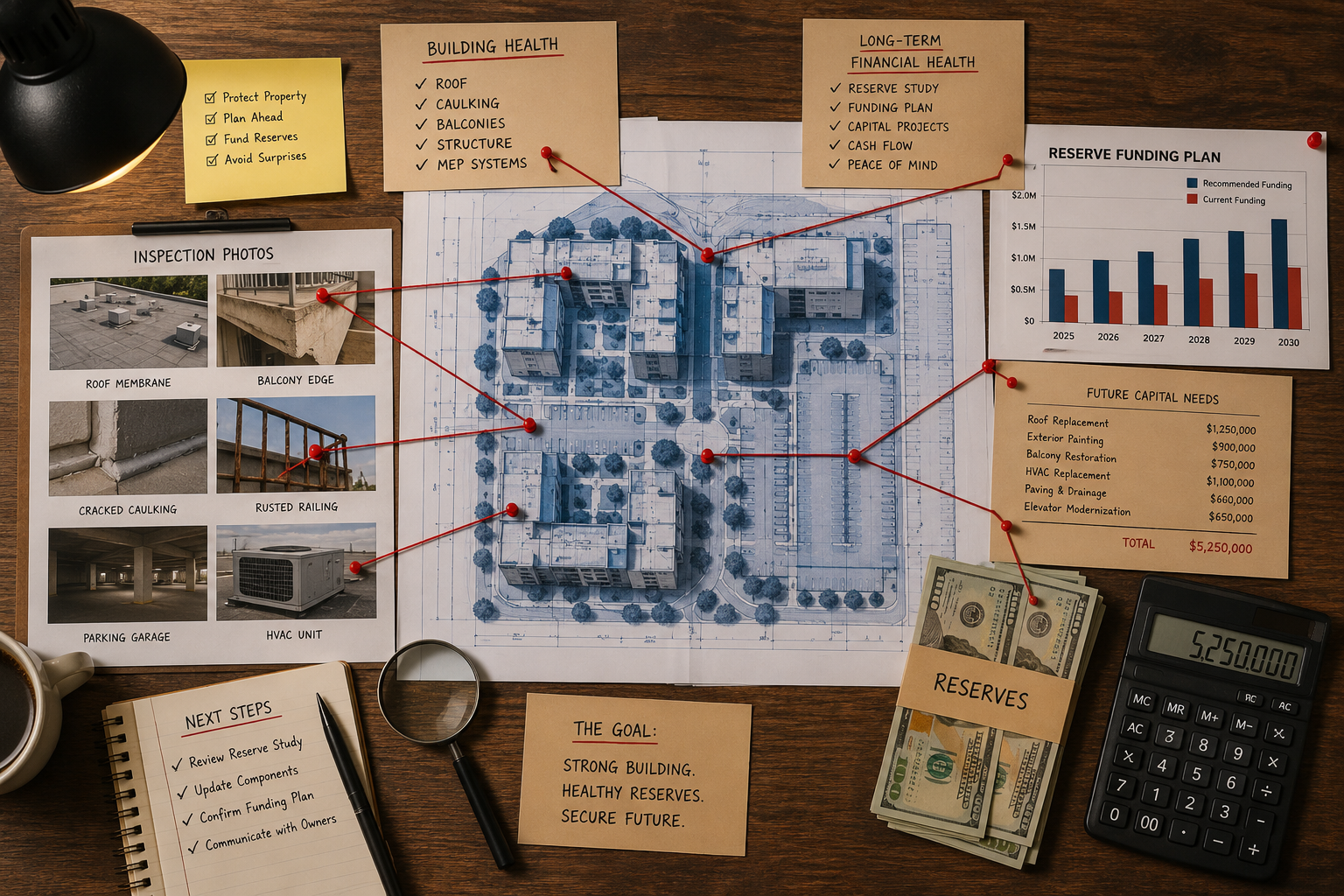
A reserve study has two halves, and reading it well means understanding both. The physical side is the component inventory: a list of all major shared assets, along with their current condition, remaining useful life, and estimated replacement cost. When you read this section, focus on the components with the shortest remaining life and the highest cost. Those drive your funding.
The financial side is the funding analysis: current reserve balance, annual contribution, projected expenses by year, and a percent-funded figure. The percent-funded number is the headline most boards look at, but it's only meaningful when the underlying physical inventory is up to date. A 90%-funded study built on a decade-old physical component inspection is not a 90%-funded community.
Read the two together, not in sequence. When the study projects a large expense in year six, cross-check it against the component's physical condition. Does the remaining useful life match? Has anything failed early? This is the reconciliation described in the previous section, applied line by line.
Watch for two warning signs. First, a funding plan that remains flat while physical components age signals that deferred maintenance is being ignored. Second, replacement costs that haven't been updated to reflect current market conditions, since construction inflation has pushed many estimates well above prior figures. Both distort the analysis and understate your future liabilities.
State requirements shape how these studies must be done. Florida's Statute 718.112 on structural integrity reserve studies and California's Civil Code reserve requirements, for example, address inspection intervals and funding disclosure. Requirements vary widely, so review the reserve study requirements by state and confirm the rules in your state's reserve statute with a qualified professional. Reading your reserve study through the lens of both physical and financial components, and against your state's specific rules, helps a board stay ahead of compliance risk rather than react to it.
Using software to connect physical inspections to financial planning
The reconciliation problem is really a data problem. Physical inspection findings live in one format, financial records in another, and connecting them by hand is where self-managed communities run out of time and energy. The right HOA management software closes that distance. It keeps the physical component inventory and the financial funding plan in the same system, so a change to one updates the other.
The value isn't fancy dashboards. It's continuity. When a treasurer resigns, the maintenance tracking history, vendor records, and reserve funding assumptions remain in place rather than vanishing. That continuity is the foundation of financial transparency, because homeowners can see how physical conditions connect to funding decisions rather than taking the board's word for it.
Good HOA management software also handles the ongoing work that keeps a reserve study honest: logging maintenance, tracking component condition over time, and updating replacement costs. Maintenance tracking feeds the physical side, while budgeting and reporting feed the financial side, and integration keeps them aligned. For volunteer board members juggling this alongside full-time jobs, that automation is the difference between a living plan and a forgotten PDF.
Solume was built specifically for self-managed communities, with reserve study tool that ties physical component data to reserve funding, plus financial management and reporting tool for budgeting and maintenance tracking that keep physical condition current. It centralizes the two analyses that most platforms treat separately, which is the exact gap this article is about.
None of this replaces professional judgment. A reserve specialist should still perform the physical inspection, and boards should consult their attorney for legal interpretation of state requirements. Software organizes the physical vs financial analysis so an HOA board can act on it, but the underlying decisions still belong to the board.
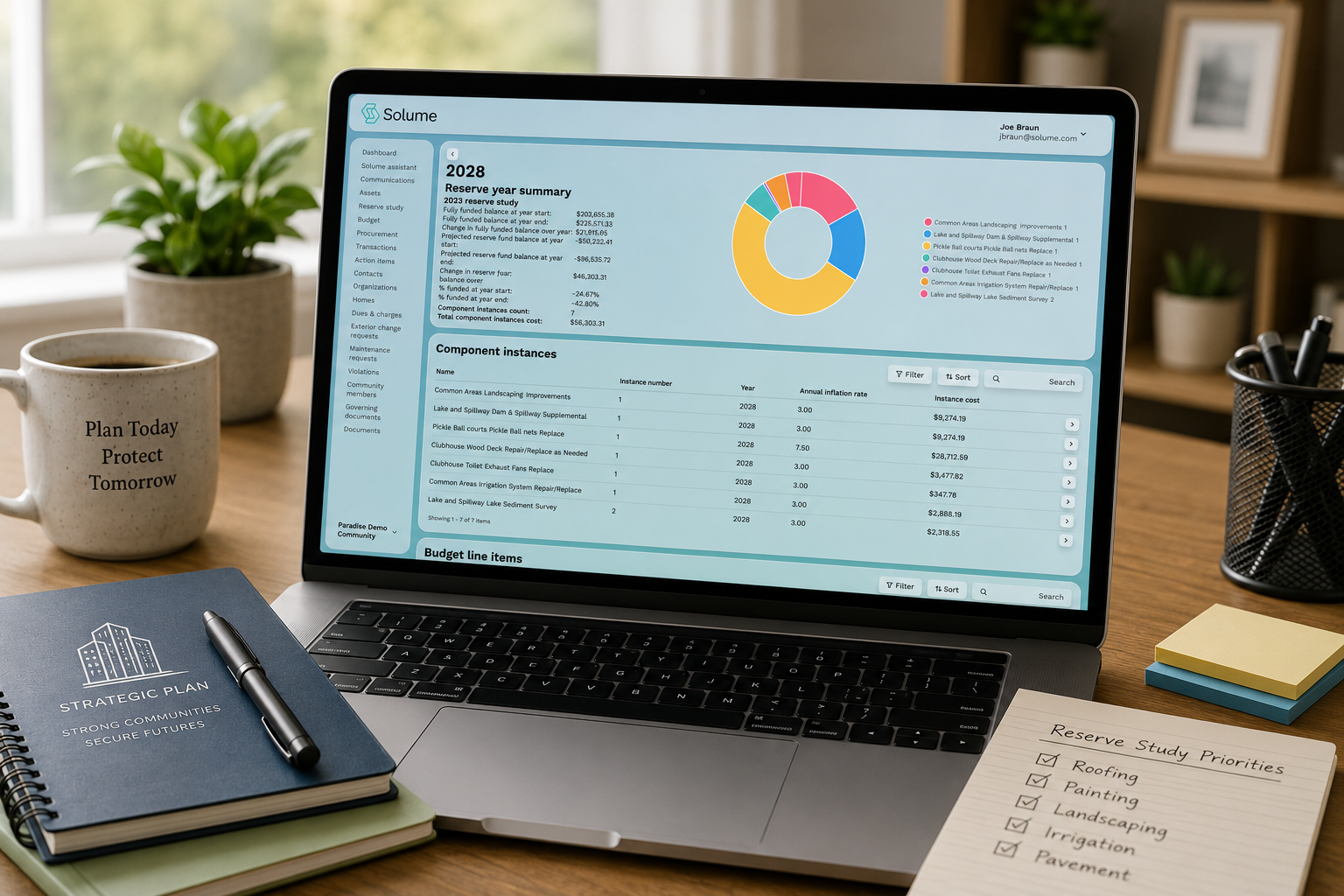
If your board wants a clearer way to align physical condition with reserve funding so you're planning for repairs instead of reacting to them, you can see how it works for your community in a 15-minute call. It's a straightforward conversation about whether the approach fits how your community operates, not a sales pitch.
Frequently Asked Questions
When should a board rely on physical analysis instead of financial analysis?
Physical analysis matters most when the condition of real assets directly affects value and cost, such as inspecting roofs, siding, or pavement during a reserve study. Financial statements alone won't tell you a 20-year-old roof is near failure. In reality, boards use physical inspections to project future repair and replacement needs, which then feed into the financial plan.
How do physical and financial analysis work together in a reserve study?
A reserve study starts with a physical component inventory that documents each asset's current condition and remaining useful life, then applies financial analysis to calculate funding levels and contribution schedules. The physical side answers 'what needs replacing and when,' while the financial side answers 'how much to set aside.' Skipping either half leads to underfunding and unexpected special assessments.
Is it worth paying for a physical inspection when we already track our finances?
Yes, because financial records don't reveal deferred maintenance or hidden deterioration until a component fails and forces an emergency assessment. A physical assessment surfaces the real condition of your assets so your budget reflects actual liabilities, not assumptions. For self-managed boards, this is the difference between planned funding and a surprise five-figure repair bill.
What happens if we skip physical analysis and only look at the numbers?
You risk building a budget on outdated assumptions, since financial statements can look healthy even as critical components quietly age out. This is how communities end up underfunded and forced into special assessments to cover repairs they never planned for. The risk most boards overlook is that a balanced budget doesn't guarantee your reserves match your buildings' real needs.
Do volunteer board members need accounting or engineering expertise to do this?
No, though the two disciplines do lean on different skills: financial analysis relies on statements and ratios, while physical analysis relies on inspection and condition assessment. Most boards bring in a reserve specialist for the physical component and use software to organize the financial side. Tools like Solume centralize both so volunteers can plan without being accountants or inspectors.
Which type of analysis is better for board decision-making?
Neither is better on its own; comprehensive decisions require both. Physical analysis tells you the true condition of your components, and financial analysis tells you whether you can fund their repair or replacement. Boards that combine the two make maintenance and funding decisions based on facts rather than guesswork.