
A single unpaid $400 assessment can spiral into a $12,000 legal fight if an HOA board mishandles the collection process. That is the trap most volunteer boards walk into without seeing it coming. Deciding when to hire a lawyer for HOA matters is not about fear. It is about knowing which problems can sink your community and which ones you can solve yourself with good records and clear procedures. This article breaks down what an HOA attorney does, when your board really needs one, how the costs work, and how state laws change the answer.
Key Takeaways
- An HOA lawyer represents the association itself, not individual homeowners, and handles governing documents, compliance, contracts, and enforcement.
- Homeowners in a dispute with their board must retain their own independent counsel, since the association's attorney is legally obligated to protect the HOA's interests.
- Litigation should be a last resort because trials can exceed $10,000 and many CC&Rs shift attorney fees to the losing party, making demand letters and mediation the smarter first steps.
- Self-managed boards can limit legal spend by using clear internal procedures and accurate records, reserving attorneys for document amendments, contracts, collections, and litigation risk.

What an HOA lawyer is and what they actually do
An HOA attorney is a lawyer whose client is the association as a legal entity. Not any single owner, and not any single board member. This distinction matters more than most boards assume. The attorney advises the board on homeowners association law, drafts and interprets governing documents, reviews contracts before the board signs them, and represents the association if a dispute reaches court.
Most of the work is quiet and preventive. A good HOA attorney spends more time keeping the board out of trouble than fighting battles. That means catching a bylaw amendment that would violate state statute, flagging a rules enforcement action that could look selective, or rewriting a vendor contract that exposes the association to liability. Small procedural errors get expensive because a court can void a decision made outside the association's own governing rules, no matter how reasonable it seemed at the time. This is also where an AI assistant that helps boards interpret governing documents and compliance rules can flag issues before they ever reach an attorney's desk.
Because associations are corporations under state law, they carry legal obligations that volunteer boards rarely learn about until something goes wrong. The Community Associations Institute publishes clear guidance on board responsibilities and legal roles in its governance resources. Reading that material before you have a problem is far cheaper than learning it during one. You can find even more of the Community Associations Institute resources for homeowner leaders on that same portal.
Common HOA legal issues a lawyer handles (governing documents, CC&R enforcement, disputes)
Most HOA legal issues fall into a handful of recurring categories, and nearly all of them trace back to the governing documents. The CC&Rs, bylaws, and rules define what the board can and cannot do. When those documents are vague, outdated, or contradictory, an HOA attorney becomes essential for interpretation and amendment.
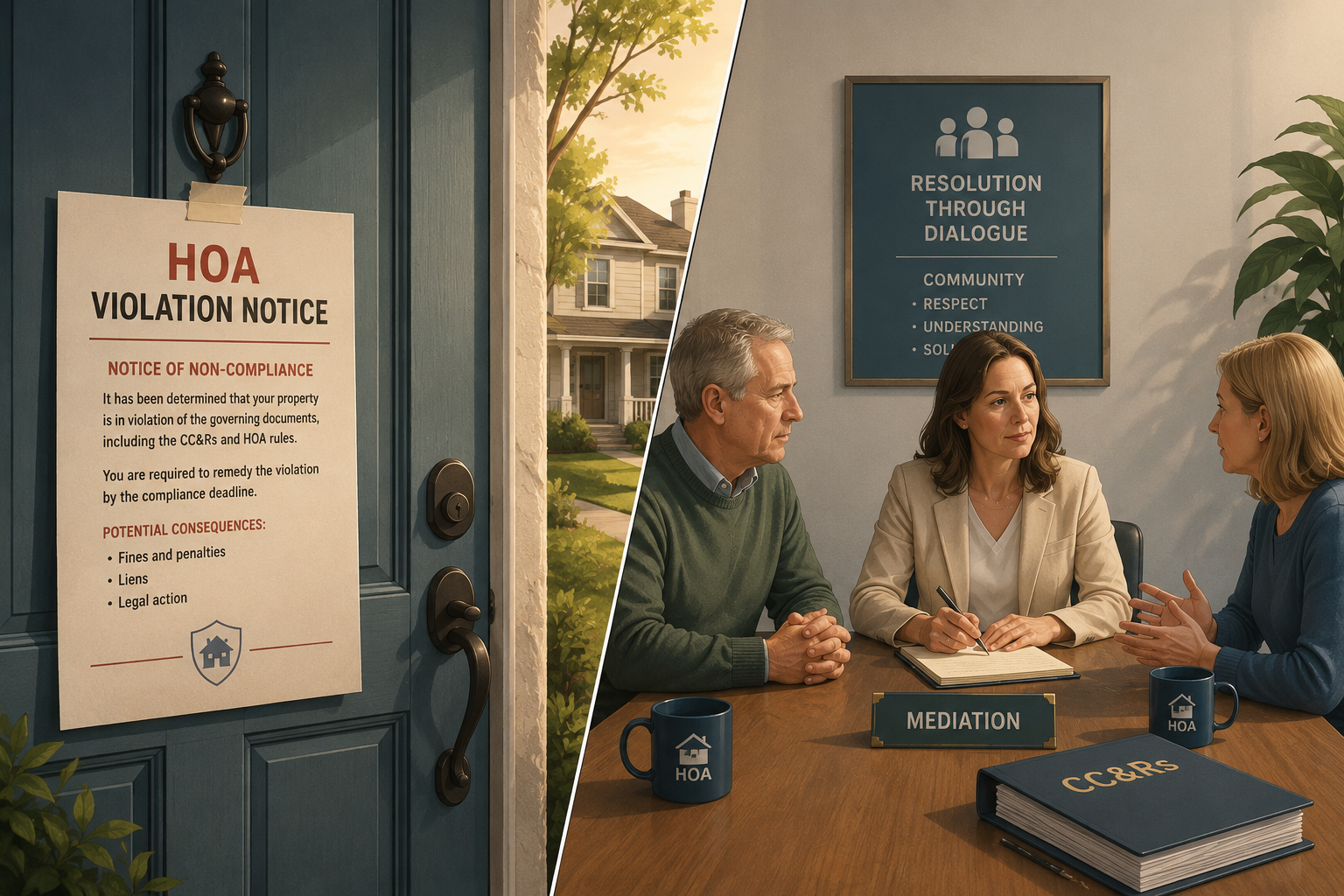
CC&R enforcement is where boards get sued most often. The root cause is almost always inconsistency, because selective enforcement gives a cited owner an equal-protection-style defense that can wipe out the entire action. A board that enforces a paint-color covenant against one owner but ignores three others has handed a homeowner a defense. Rules enforcement only holds up when it is applied evenly and documented. Most boards assume a rule is enforceable simply because it appears in the CC&Rs. In reality, a rule can be void if it conflicts with state law or was adopted without the proper vote. If you want a candid look at the red flags and insider secrets of HOA management, the enforcement inconsistency trap is one of the most common ones boards fall into.
Discrimination complaints, architectural disputes, and fair-housing questions add another layer. The U.S. Department of Housing and Urban Development explains protected classes and reasonable-accommodation duties in its Fair Housing Act overview. An HOA dispute that touches those areas should go to counsel right away, before the board responds in writing.
Assessment collections, delinquent dues, liens, and foreclosure
Delinquent assessments are the single most common reason a self-managed board calls a lawyer. They are also the area where boards do the most self-inflicted damage. The collection process follows strict statutory steps, and skipping one can invalidate the entire effort.
The typical sequence starts with a late notice, moves to a formal demand letter, then to recording an HOA lien against the property, and only as a last resort to HOA foreclosure. Assessment collections must follow the exact notice periods and cure opportunities your state requires. Here is the hard truth: a board that records a lien with the wrong amount, or skips a required pre-lien notice, can lose its ability to collect. It may even owe the homeowner's legal fees.
The reason this matters is cash flow. Unpaid dues do not just represent one owner's debt. They force the rest of the community to cover the shortfall, often through special assessments. Solume automates dues collection for self-managed boards, tracking delinquencies and building the documented timeline an attorney needs if a case ever escalates. Much of that timeline depends on keeping clean HOA financial records, so the dollar amounts on any lien are provable. Getting the paper trail right early is what keeps HOA liens and HOA foreclosure off the table.
When a self-managed HOA board actually needs a lawyer vs. when it doesn't
Not every question needs an HOA attorney. A self-managed HOA can handle routine matters in-house: sending a standard violation notice, approving a straightforward architectural request, scheduling association meetings, or answering a homeowner's records request. Clear internal procedures and accurate records solve most of these without a bill.
You need a lawyer when the stakes turn legal or expensive. Amending governing documents, negotiating a contract worth thousands of dollars, pursuing a stubborn delinquent account toward foreclosure, or responding to a threatened lawsuit are all moments where a lawyer for HOA guidance pays for itself. The compliance risk of guessing wrong on these is far greater than the legal fee.
Picture a self-managed HOA that amended its bylaws by email vote to save time. Two years later, an owner challenged an enforcement action. The amendment was ruled invalid because the state required a mailed ballot, and the board spent $9,000 unwinding the mess. A single consultation would have prevented it. Board members carry a fiduciary duty to the association, and that duty includes knowing the limits of their own expertise.

HOA litigation and dispute resolution basics
HOA litigation is the worst-case outcome, and every board should treat it that way. Trials are slow, public, and expensive. Many CC&Rs also contain a prevailing-party fee clause that forces the loser to pay both sides' legal fees. That clause cuts both ways: an aggressive board that loses can hand a homeowner a five-figure judgment.
This is why dispute resolution should start with the cheapest tools first. A well-drafted demand letter resolves many conflicts before anyone files anything. If that fails, mediation and arbitration are faster and far cheaper than court. Several states now require an alternative dispute resolution step before an HOA dispute can proceed to trial. If an individual owner needs to line up their own counsel, the American Bar Association's guidance on finding legal help is a reliable starting point.
Most boards assume that being "right" guarantees a win. In reality, courts look at whether the board followed its own procedures and applied its rules consistently. A technically correct position can still lose on process grounds. When litigation is genuinely unavoidable, whether the association is pursuing a claim or acting as an HOA defense attorney's client, documentation is everything. The board with clean minutes, dated notices, and consistent enforcement records almost always has the stronger position.

State-specific HOA law differences (Florida, California, Colorado, Texas, Carolinas)
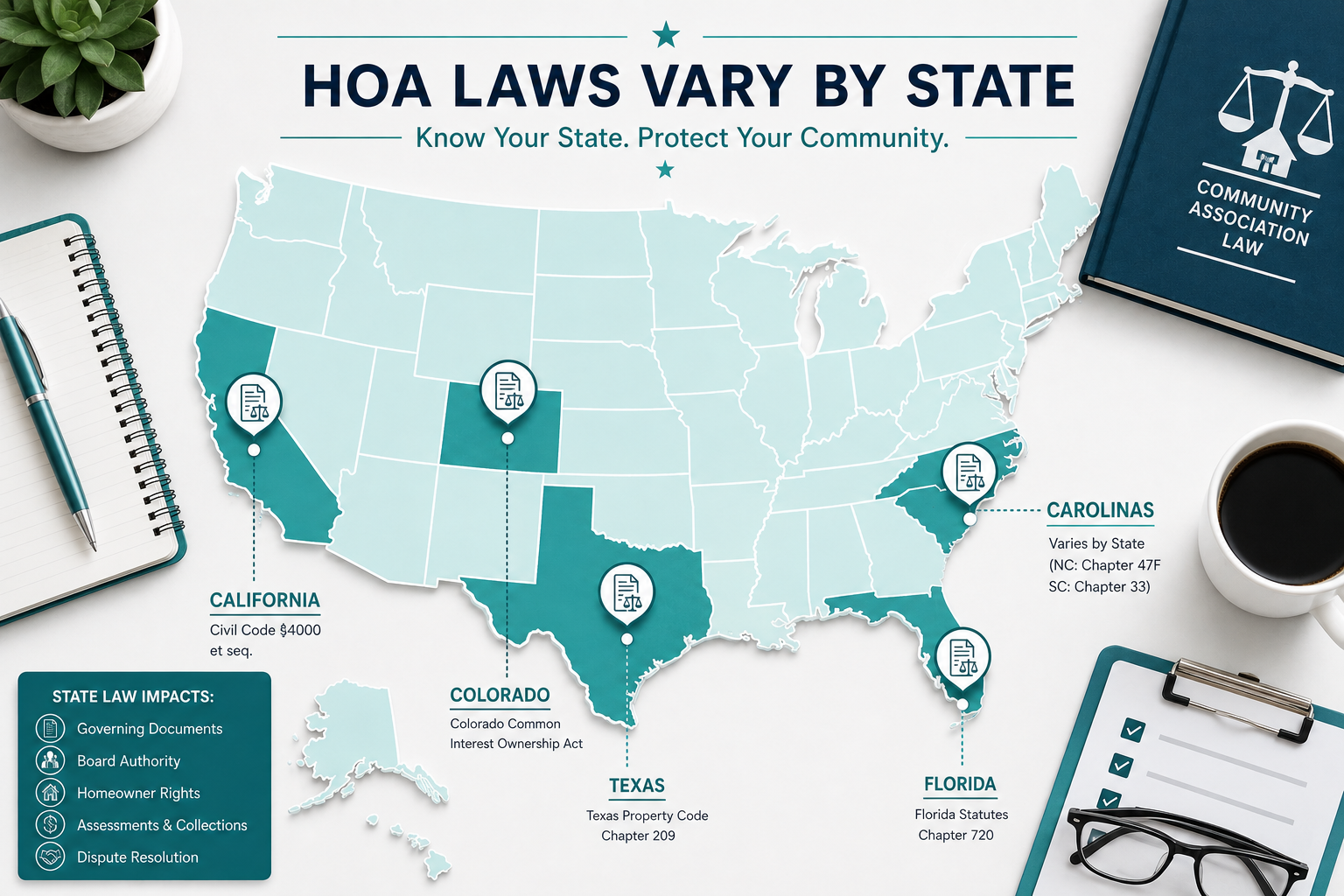
Homeowners association law is written at the state level, so the correct answer to almost any HOA question depends on where your community sits. This is the point boards most often miss when they copy a policy from a neighboring association across a state line.
Florida HOA rules tightened sharply after the 2021 Surfside condominium collapse that killed 98 people. The state now mandates Structural Integrity Reserve Studies and milestone inspections for many condo buildings, and condo association law there carries strict reserve-funding requirements under Florida Statutes Chapter 720 governing homeowners' associations. California HOA law, primarily the Davis-Stirling Act, imposes detailed rules on elections, meetings, and reserve disclosures. Colorado HOA statutes require registration and specific pre-foreclosure procedures spelled out in the Colorado Common Interest Ownership Act statute text. Texas HOA law limits how and when an association can foreclose and mandates payment plan offers. The Carolinas each have their own planned-community and condo acts with distinct notice rules.
These differences are significant and change frequently. Always confirm any rule against your state's community association statute and consult your association's attorney for legal interpretation. Because reserve funding rules vary so widely, it is worth reviewing the state-by-state reserve study and compliance requirements before you set your budget. A generic answer from the internet is not a substitute for your own state code. Statutory compliance is jurisdiction-specific by design.
How HOA legal fees and costs work (flat fees, retainers)
Legal fees are the reason many boards avoid attorneys entirely. That is a mistake, but the fear is understandable. Understanding how billing works lets a board budget instead of panic.
Most community association attorneys bill in one of three ways. Hourly rates are common for open-ended matters like litigation, often a few hundred dollars per hour depending on the market. A flat fee is typical for defined tasks: reviewing a contract, drafting a rule, or handling a standard collection file. Some associations keep an attorney on retainer, paying a set monthly amount for a bank of hours and quick access to advice.
Here is what many communities do not realize: most self-managed boards do not need a retainer at all. Paying for work as needed- an annual document review here, a single collection matter there- is usually cheaper than a standing monthly fee. The way to keep total legal fees down is to reduce how often you need a lawyer, because most of what drives up an attorney's bill is time spent reconstructing records the board should have kept in the first place. Solume's financial management and reserve study tools help boards keep the accurate, well-documented records that shrink the hours an attorney has to bill. Clean books mean fewer surprises and lower compliance risk.
Meetings, parliamentary procedure, and statutory compliance
Sloppy meetings create more legal exposure than most boards ever suspect. If an HOA board makes a decision without proper notice, a quorum, or a recorded vote, that decision can be challenged and thrown out, even if it was the right call.
Statutory compliance around association meetings usually covers three things: advance notice to owners, open-meeting requirements, and accurate minutes. Most states let owners attend board meetings and require the board to post an agenda in advance. Parliamentary procedure, often loosely based on Robert's Rules, exists to make sure motions, discussion, and votes happen in an order that is fair and defensible later.
The risk most boards overlook is the paper trail. Minutes are not a formality. They are the evidence that the board acted properly. A management company usually handles this, but a self-managed HOA or condo association has to build the discipline itself. This is where HOA management software earns its keep, and choosing software built for self-managed boards makes that discipline far easier to sustain. Centralizing notices, agendas, votes, and records in one system, rather than scattering them across personal email inboxes, protects board members personally and keeps decisions enforceable.
The Legal Pressures of HOA Management: A Solution
Managing an HOA or condo community comes with significant legal pressures. Board members are volunteers, but their responsibilities can carry serious legal implications. If rules are applied unevenly, if homeowners are kept in the dark, or if violations are issued without due diligence, the board opens itself to legal challenges. The reality is, the stakes are high.
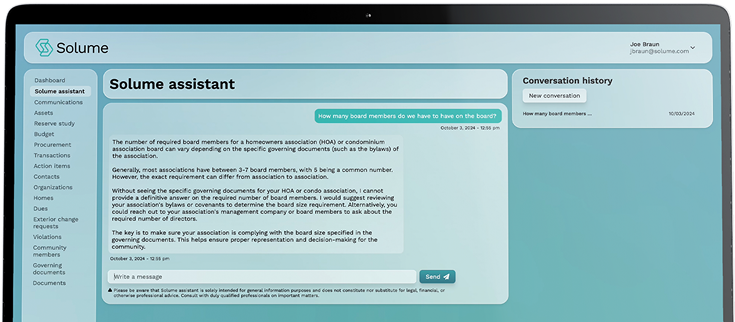
Solume Assistant offers a solution that reduces these risks. By providing instant, AI-powered guidance, it helps board members make informed decisions confidently, ensuring compliance and minimizing the potential for costly disputes. No one wants to see their community embroiled in a legal battle. With Solume Assistant, homeowners and board members alike can avoid the pitfalls that lead to lawsuits, fostering a harmonious and well-managed community.
Take Control of Your Community's Future
Whether you're a board member or a homeowner, understanding your rights and responsibilities within an HOA is crucial. Legal disputes are not only costly but can also tear communities apart. The goal should always be to resolve issues before they require a lawyer. Solume Assistant helps achieve that by providing fast, reliable guidance tailored to your community's governing documents and legal obligations.
If your board wants a clearer way to manage dues collection, reserve planning, compliance records, and vendor oversight without depending on a management company, you can book a 15-minute call to see if Solume fits your community. It is a low-pressure conversation about whether the tools actually solve the problems your board is facing.
Disclaimer: Please be aware that Solume Assistant is solely intended for general informational purposes and does not constitute nor substitute for legal, financial, or otherwise professional advice. Always consult with duly qualified professionals regarding important matters.
Frequently Asked Questions
What does a lawyer for an HOA actually do?
An HOA lawyer represents the association as a legal entity, drafting and amending governing documents like CC&Rs and bylaws, advising the board on state and federal compliance, and handling covenant enforcement or assessment collection. They also review vendor and management contracts before the board signs them.
What are HOA lawyers called, and what type should I look for?
HOA lawyers are typically real estate attorneys with community association experience, and some hold the College of Community Association Lawyers (CCAL) credential. Discrimination claims may call for a civil rights attorney, while courtroom disputes may require a civil litigation attorney.
If I'm a homeowner in a dispute, can I rely on the HOA's lawyer?
No. The HOA's attorney represents the association's interests only, even when those interests conflict with an individual homeowner's. If you're in a dispute with your board, you need to hire your own independent attorney to advocate for you.
When should a self-managed board hire a lawyer instead of handling it internally?
Boards should bring in counsel when drafting or amending governing documents, negotiating vendor and management contracts, pursuing delinquent assessments, or facing any threat of litigation. Routine compliance questions and record-keeping can often be managed with software and clear procedures, reserving legal spend for higher-risk matters.
What if our HOA can't afford ongoing legal fees?
Many associations use attorneys on an as-needed basis rather than a retainer, budgeting for one-off tasks like an annual document review or a specific dispute. Strong internal governance, accurate financial records, and consistent enforcement reduce how often legal intervention is needed in the first place.