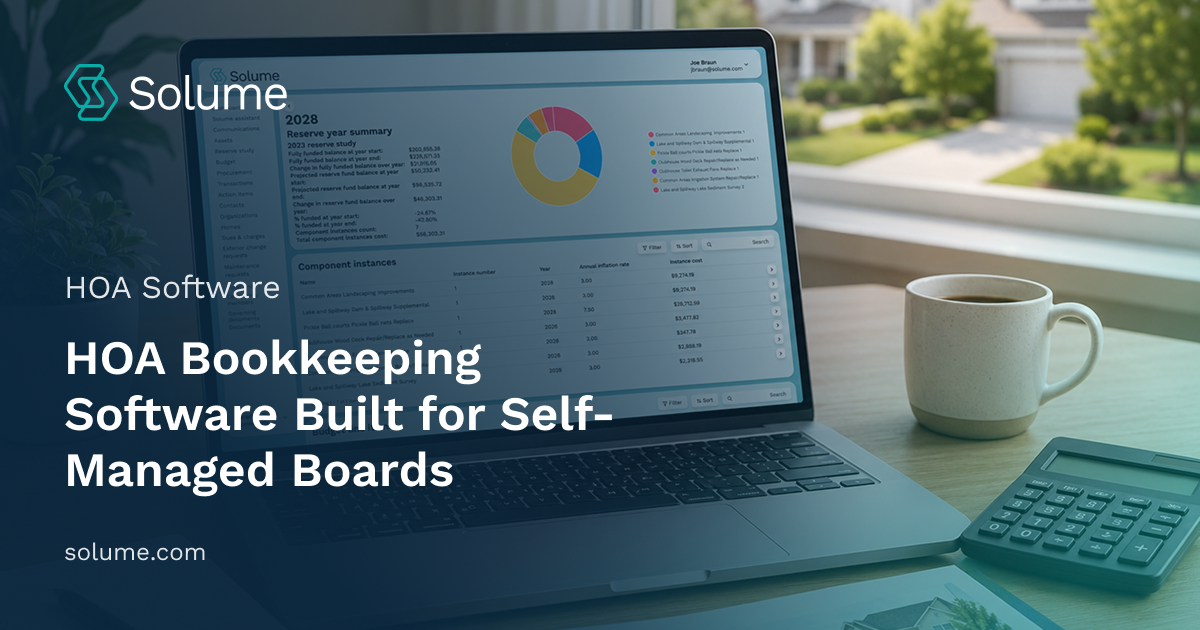
A treasurer in a 60-unit Florida condo association once told me she spent eleven hours every month reconciling dues against a spreadsheet. She still missed three delinquent owners because their payments landed in the wrong column. That kind of error compounds quietly until an audit or a special assessment forces it into the open. The right HOA bookkeeping software removes that risk. It keeps the books accurate without demanding accounting credentials from volunteers. This article walks through what these tools do, why spreadsheets fail self-managed boards, and how the right features protect your community's finances.
Key Takeaways
- HOA bookkeeping software automates dues invoicing, payments, reconciliation, and reporting while keeping operating and reserve funds separate, as required by law.
- General-purpose tools like QuickBooks lack native fund separation and owner tracking, forcing self-managed boards to rely on error-prone manual workarounds.
- The accrual accounting method is the GAAP-compliant standard most auditors recommend for an accurate view of an association's finances.
- The biggest financial risk for self-managed boards is staying on spreadsheets, where missing fund separation and reserve planning invite compliance and fraud problems.

What HOA bookkeeping/accounting software is
HOA accounting software is a financial system built specifically for a community association, not for general small businesses. It handles homeowner invoicing, automated dues collection, payment processing, bank reconciliation, accounts payable, accounts receivable, and financial reporting in one place. The defining feature is fund accounting: keeping operating money and reserve money in separate ledgers. Most states and governing documents require it. Boards looking to centralize these tasks often start with financial management tools built for HOA boards rather than stitching together generic apps.
What sets HOA bookkeeping software apart from a generic tool is its understanding of how a community association actually operates. It tracks individual units and owners, applies assessments per unit, flags delinquencies, and produces the automated reports a board needs for meetings and tax preparation. According to the Community Associations Institute, associations have a fiduciary duty to manage member funds responsibly. Accurate records are the foundation of that duty, and the AICPA standards for nonprofit and association accounting provide the professional benchmarks most auditors apply to those records.
Here's why this matters. A board cannot demonstrate financial responsibility to homeowners if its numbers are kept in a private spreadsheet that nobody can verify. Good HOA accounting software builds financial transparency into the daily workflow rather than treating it as an afterthought. If you're just getting started, our guide to bookkeeping for a small HOA breaks the fundamentals down further.
Why self-managed boards need dedicated bookkeeping software vs spreadsheets
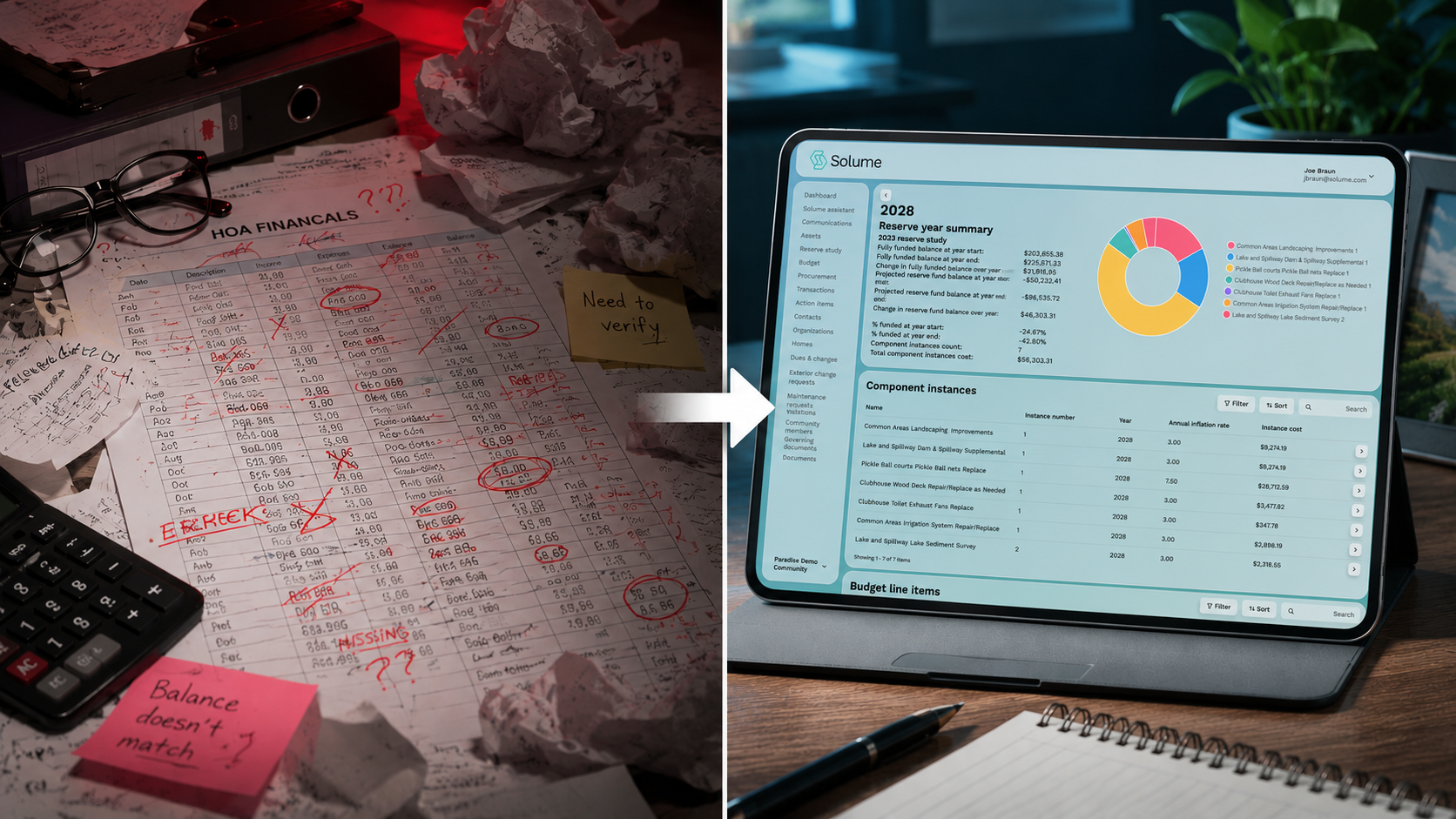
Here's the hard truth: spreadsheets and QuickBooks were never built to enforce the rules HOAs operate under. QuickBooks can record transactions, but it won't stop you from commingling operating and reserve funds. It has no native concept of a homeowner or a unit. Self-managed boards end up building fragile workarounds: custom classes, manual tags, side spreadsheets. They break the moment a volunteer treasurer rotates off the board. A purpose-built QuickBooks alternative avoids those gaps entirely.
The risk most boards overlook is succession. When the one person who understood the spreadsheet leaves, that knowledge walks out the door. Reconstructing the books costs money and trust. The 2021 collapse of Champlain Towers South in Surfside, Florida, killed 98 people. It has pushed states toward stricter reserve and reporting laws.
Moving from spreadsheets to software is not a luxury for volunteer board members. It is the difference between a defensible financial record and a folder of guesses. A purpose-built HOA management software platform automatically enforces fund separation, owner tracking, and assessment tracking. If you're comparing options, our roundup of the best HOA management software for self-managed boards walks through the leading platforms side by side.
Automated dues, assessments, and invoicing collection
Chasing dues is the single biggest time drain for volunteer boards, and it is also where revenue leaks. Manual homeowner invoicing means someone has to remember to send statements, track who paid, and follow up on who didn't. Miss a few owners for a few months, and your operating cash gets tight fast.
Automated dues collection fixes this. It generates recurring invoices on a schedule and accepts payment through ACH and credit card processing. Owners get reminders automatically, payments post to the correct ledger, and delinquencies surface on a dashboard rather than in someone's memory. Assessment tracking works the same way. When the board levies a charge, the system applies it per unit and monitors its collection without anyone having to rebuild a spreadsheet. Simplified dues collection and payment tracking are often the first areas where boards see measurable time savings.
Automation shifts the treasurer's role from a data-entry clerk to a financial overseer. solume-2 automates dues collection and homeowner invoicing for self-managed boards, including flexible payment options, so accounts receivable stay current without manual chasing.
Financial reporting and real-time transparency
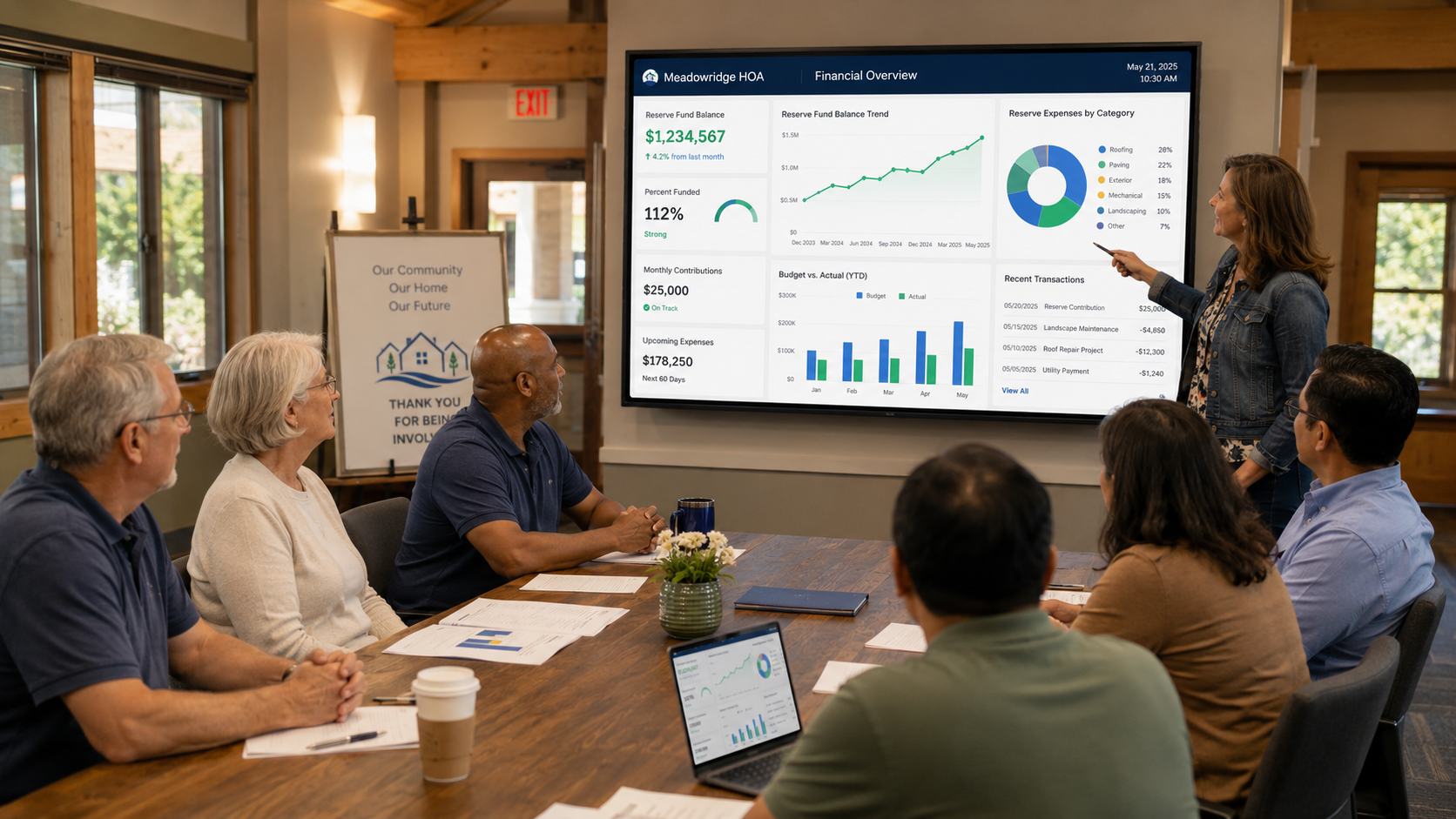
Most boards assume financial transparency means emailing a PDF balance sheet once a quarter. In reality, homeowners want to see where their money goes, and they trust a board that can show them without delay. Real-time accounting turns the books into a living record that any authorized member can review.
Automated reports replace the late-night scramble before a board meeting. Instead of hand-building a balance sheet and income statement, the software produces them on demand: balance sheets, budget-versus-actual comparisons, delinquency summaries, and reserve fund tracking statements. That real-time accounting also feeds directly into tax preparation and the year-end audit, which saves accountant fees. Boards filing their annual return should review the IRS guidance on homeowners' association tax filing to understand which forms apply to their association.
The root cause of most homeowners' distrust is opacity. When residents cannot see the numbers, they assume the worst, and that is how recall petitions and lawsuits start. Building financial transparency into daily operations does more than satisfy curiosity. It documents the board's fiduciary duty and protects volunteers from accusations of mismanagement. Clean, current financial reporting is the cheapest insurance a board can buy.
Key features to look for when choosing HOA software
When evaluating HOA accounting software, start with the non-negotiables. The platform must support true fund accounting that separates operating and reserve money. That separation is a legal requirement in most states, not a preference.
The features to look for, in rough priority order:
- Automated dues collection with ACH and credit card payment processing
- Bank integrations that pull transactions in for faster bank reconciliation
- Accounts receivable and accounts payable tracking with delinquency flags
- Reserve fund tracking and reserve study integration for long-term planning
- Automated reports covering balance sheets, budgets, and compliance tracking
- Budgeting tools that compare actual spending against the approved budget
- Compliance tracking tuned to your state's statutes
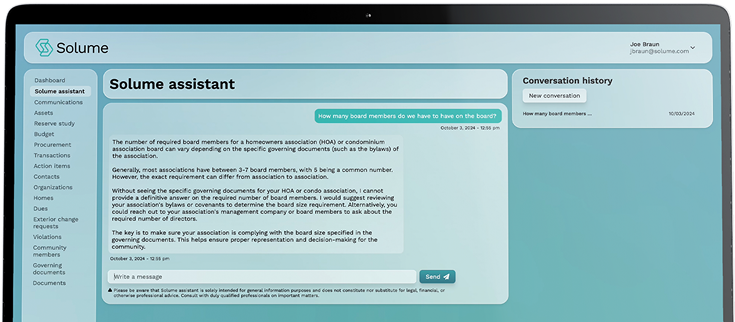
Beyond accounting, the strongest HOA management software platforms bundle maintenance tracking, vendor management, and architectural requests. The board runs the entire community from a single system rather than five disconnected tools. An AI assistant that explains governing documents and state compliance questions is increasingly valuable for volunteer board members without legal training.
One feature most platforms ignore is reserve study integration. Many assume any condo accounting software handles long-term capital planning. In reality, most stop at operating cash, with no budgeting tools for reserves. If you need help drafting your annual budget, our step-by-step HOA budget template provides boards with a practical starting point. A free trial lets you test the workflow before committing.
Migration from spreadsheets/old software to a new platform
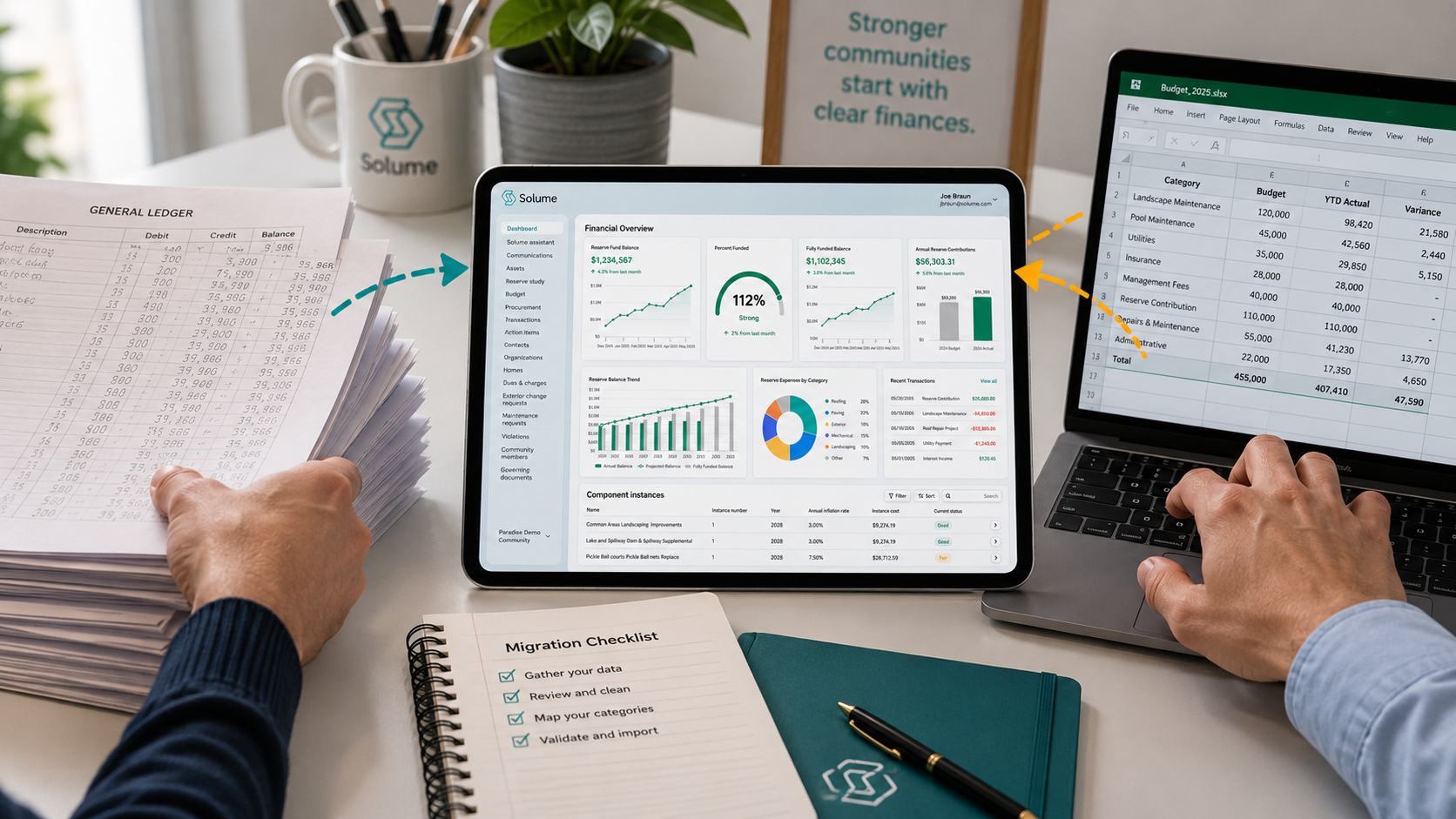
Moving from spreadsheets to software sounds intimidating, and that fear keeps too many boards stuck on broken systems for years. The actual process is more manageable than most treasurers expect, especially with a vendor that helps with onboarding.
Start by picking a clean cut-off date, usually the start of a fiscal year or a month-end. Export your current owner list, unit records, and account balances. Reconcile your bank accounts to a known-good number before you import anything. Migrating reconciled figures means you are not carrying over old errors. Then load the opening balances for the operating and reserve funds separately, so fund accounting starts correctly from day one.
The transition from spreadsheets to software also exposes previously hidden problems: duplicate owners, uncollected assessments, and missing reserve contributions. That discovery is uncomfortable but valuable. Better to find a $4,000 collection gap during migration than during an audit.
Run the old and new systems in parallel for one billing cycle if you can. That overlap confirms that automated dues collection and bank reconciliation are working before you fully retire the spreadsheet. A good HOA management software vendor will guide self-managed boards through this process rather than leaving them to figure it out on their own.
Time savings and automation benefits for boards
Board burnout is real, and it usually starts with the treasurer. The volunteer who signed up to help the community ends up spending entire weekends reconciling accounts and emailing late notices. Automation gives those hours back.
Consider what disappears when you use the right condo accounting software. Automated dues collection eliminates manual invoicing and follow-up. Bank integrations turn bank reconciliation from a multi-hour chore into a few clicks of matching. Automated reports are built for every meeting. Accounts payable workflows route vendor bills for approval rather than relying on a single person's inbox.
This amounts to a board that spends its limited volunteer energy on decisions rather than on data entry. A treasurer who once spent ten hours a month on bookkeeping can drop to two or three, and the work that remains is review rather than reconstruction. For boards that want to go deeper, we publish more HOA accounting resources covering reconciliation, reporting, and reserves.
There is a fraud-prevention angle, too. Manual systems with a single person controlling the books are where embezzlement hides. Automated reports, audit trails, and bank integrations create the segregation of duties and visibility that make theft far harder to conceal. Time savings and fraud prevention come from the same source: a system that automatically records everything.
Avoiding special assessments through proactive bookkeeping and reserve planning
The risk most boards overlook is the slow-motion underfunding of reserves. Roofs, pavement, and elevators wear out on a predictable schedule, yet many communities collect just enough to cover this year's bills. Then a major repair comes due, the reserve account is short, and the board has no choice but to levy a special assessment that homeowners never saw coming.
Deferred maintenance is the quiet killer here. Skipping a $20,000 sealcoat today can mean a $200,000 repaving project in eight years. Proactive bookkeeping ties maintenance tracking to reserve fund tracking, so the board sees the funding gap years before it becomes a crisis.
Reserve planning is where most software falls short, treating reserves as just another account. Solume includes automated reserve study tools and compliance tracking that connect your long-term capital plan to your actual reserve balances. A self-managed community association can fund liabilities steadily instead of through emergency special assessments.
This is financial responsibility in practice. Long-term planning backed by accurate reserve fund tracking turns surprise assessments into scheduled, fully funded projects, which is what community stability actually requires.
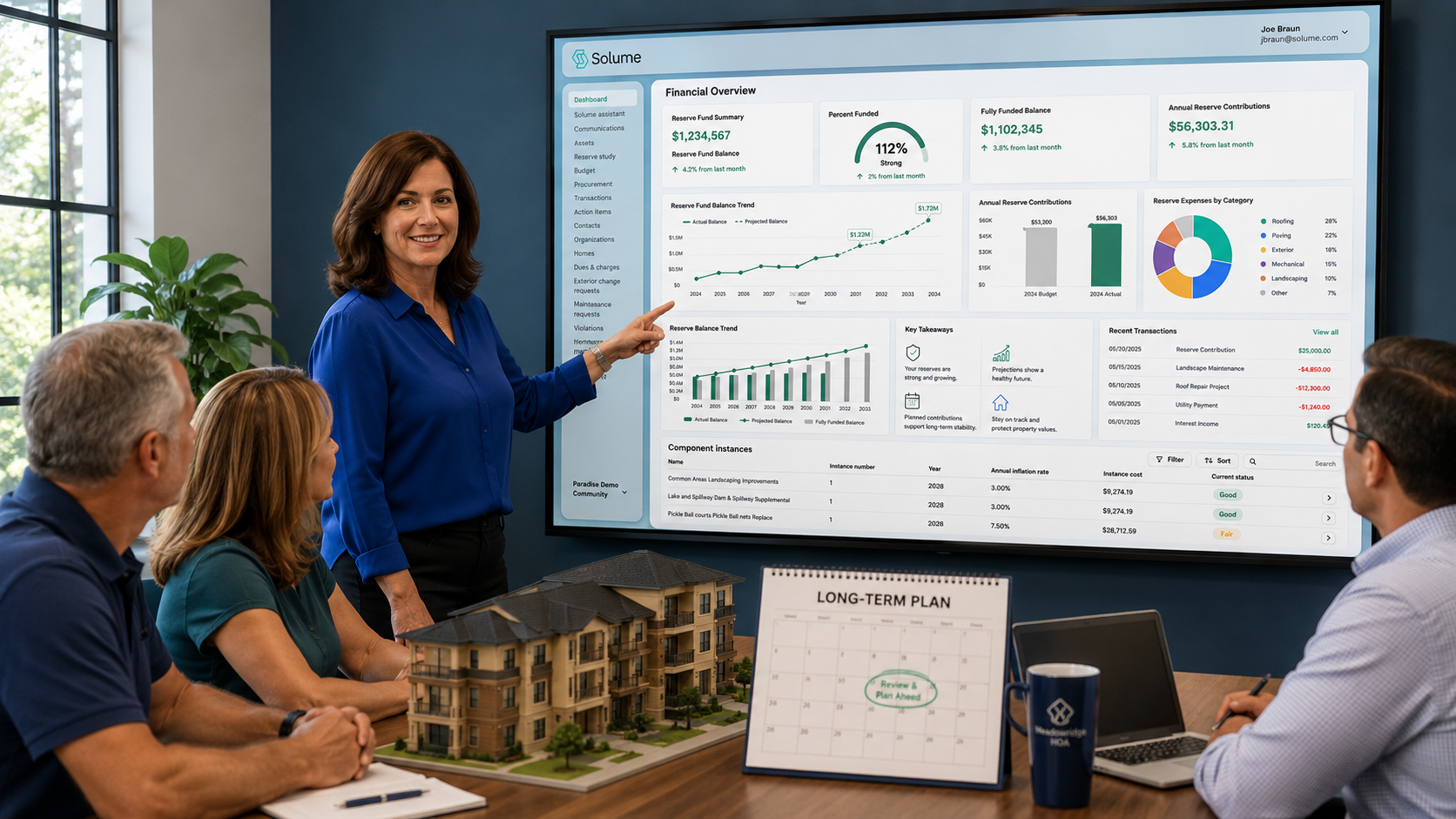
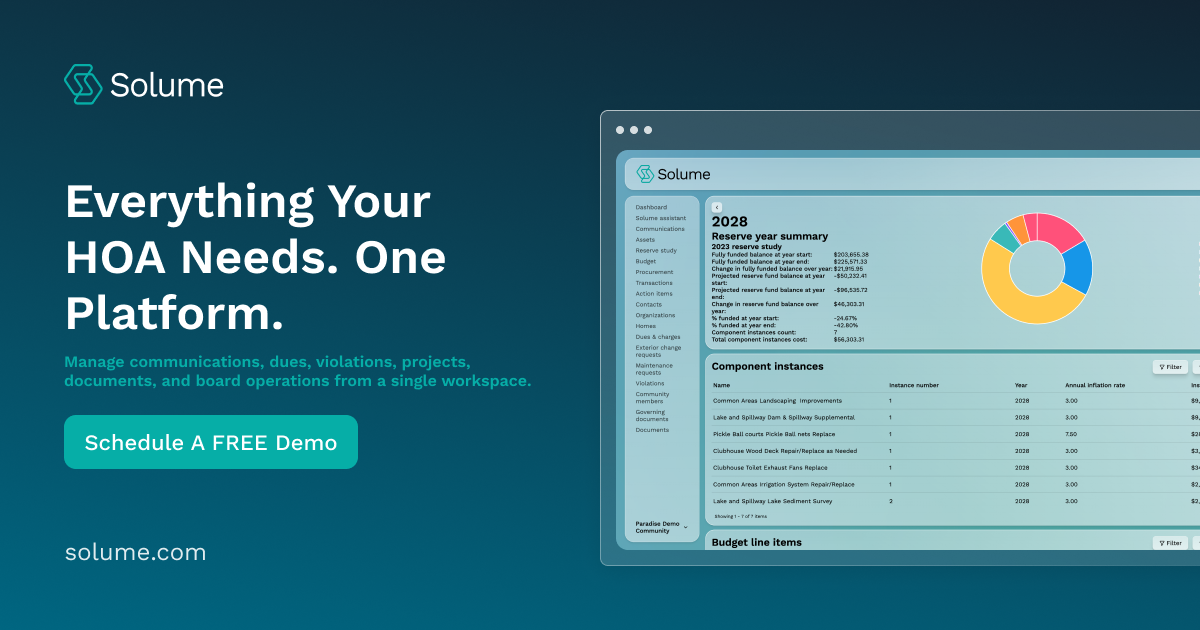
If your board wants a clearer way to manage finances, reserve planning, and vendor oversight without depending on a management company, it helps to see the system in action first. You can book a 15-minute call to see if Solume fits your community and walk through your specific reserve and compliance situation with someone who builds the platform.
Frequently Asked Questions
What is HOA bookkeeping software, and what does it actually do?
HOA bookkeeping software is a specialized tool that manages an association's finances, automating tasks like dues invoicing, online payment processing, transaction coding, and financial reporting. Unlike spreadsheets, it keeps real-time, audit-ready records that improve transparency for both boards and homeowners.
How is HOA bookkeeping software different from QuickBooks?
HOAs are legally required to keep operating and reserve funds separate, and QuickBooks doesn't enforce that fund separation, which can lead to commingling. HOA-specific software also natively tracks individual units and owners, while QuickBooks requires workarounds to handle dues, delinquencies, and homeowner records.
What features should a self-managed board look for?
Prioritize automated invoicing with ACH and credit card payments, direct bank integration for easier reconciliation, delinquency tracking, and true fund accounting that separates reserves. For self-managed boards, reserve study integration and compliance tracking matter more than generic accounting tools, since most platforms ignore long-term capital planning.
Which accounting method should our HOA use?
The accrual basis is generally considered the best method for HOAs because it records income when earned and expenses when incurred, giving a more accurate picture of financial health. It's also GAAP-compliant and recommended by most auditors and accounting professionals.
What if our board already uses QuickBooks and it's working fine?
QuickBooks can function for an HOA, but here's the hard truth: it wasn't built to enforce reserve fund separation or track owners and delinquencies, so boards often rely on manual workarounds. If your community has growing reserve obligations or state compliance requirements, purpose-built software reduces the legal and financial risk those gaps create.
Will volunteer board members without accounting experience be able to use it?
Most modern HOA platforms are built for non-experts, using plain-language dashboards and automation so treasurers and presidents don't need an accounting background. Look for tools with built-in compliance guidance and reserve planning, since those features help boards make sound decisions without hiring a management company.