A pipe bursts on the fourth floor of a mid-size condo building. Water floods three units below, ruins drywall, warps hardwood, and destroys two owners' furniture. Then the argument starts: whose insurance pays for what? This is the exact moment most owners realize they never understood their condo association insurance policy. By then the board is already fielding angry calls. Here's what the master policy covers, where individual owners are responsible, who foots the bill, and how boards keep coverage current without getting blindsided.
Key Takeaways
- Condo association insurance, or the master policy, covers the building's structure, common areas, and shared amenities, plus liability for incidents in those spaces.
- The coverage type: bare walls versus all-in: determines whether unit interiors like flooring and cabinetry fall to the association or to each owner's HO-6 policy.
- Individual owners need a separate HO-6 policy, since the master policy alone leaves personal property and unit interiors exposed depending on how it's written.
- Master policy premiums range from roughly $3,500 for small communities to over $100,000 for high-rise buildings, funded by owners through dues based on common-interest percentage.
- Coverage gaps and high deductibles between the master policy and owner policies are a leading cause of surprise special assessments after a major claim.
What condo association insurance actually covers (types of coverage included)
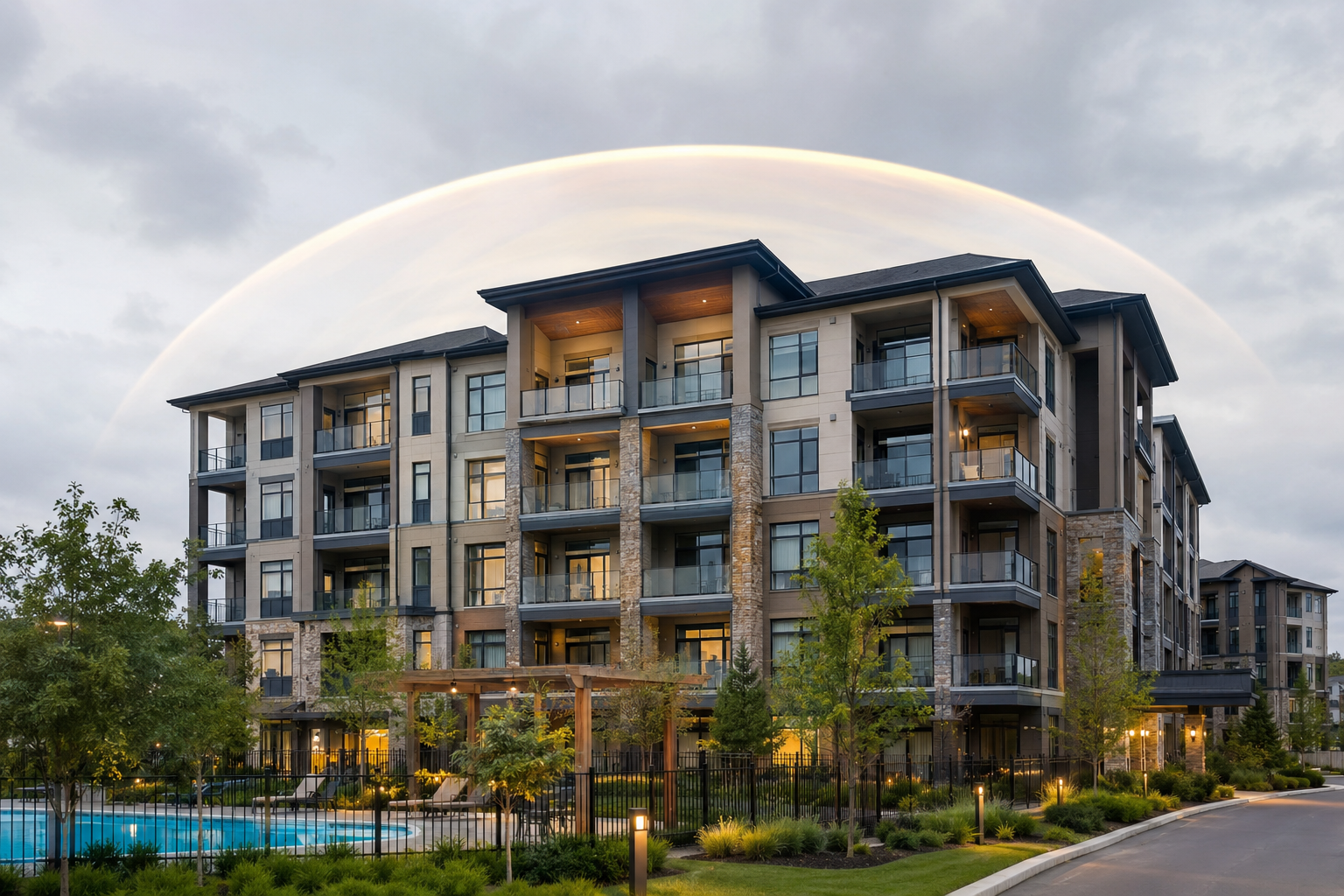
So what does condo association insurance cover in practical terms? The master policy carried by the association handles the shared parts of the property. That means property coverage for the building's structure, the roof, exterior walls, foundation, and shared amenities like elevators, lobbies, pools, and clubhouses. It also carries liability coverage for injuries or property damage in the common areas. A guest slips on the pool deck, a delivery driver trips in the lobby, and the policy responds.
Most condo association insurance also includes fidelity or crime coverage to protect against theft of funds. Many policies bundle directors and officers insurance to shield the board itself. The scope of a condo building coverage plan depends on whether it's written as bare walls or all-in, which we'll get to shortly.
For a plain-language breakdown of how these policy types are structured, the National Association of Insurance Commissioners' condo insurance guide is a useful starting point. If you want to understand how these policies fit within broader coverage principles, the CFPB's explanation of homeowners insurance basics clarifies the fundamentals. In reality, the policy defines a boundary. Everything on the association's side of that line is the community's financial responsibility. Get that boundary wrong, and the community pays twice: once for coverage it assumed it had, and again for the repair the policy never touched.
Condo association insurance vs. individual condo owner (HO-6) insurance
Here's where the condo insurance vs association insurance confusion lives. The master condo policy stops at a defined point, and the owner's HO-6 policy picks up from there. The master policy handles the building shell and common areas. Your HO-6 policy handles the inside of your unit: personal belongings, upgrades, and personal liability.
The dividing line comes down to how the master condo policy is written. Bare walls coverage stops at the unpainted interior wall surfaces, leaving flooring, cabinetry, appliances, and fixtures to each owner. All-in coverage extends into the unit and covers those interior elements, shrinking what your HO-6 policy needs to replace. Most owners assume the master policy covers their kitchen remodel. In reality, under a bare walls policy, it almost never does, because the policy language treats owner upgrades as personal property the association never agreed to insure.
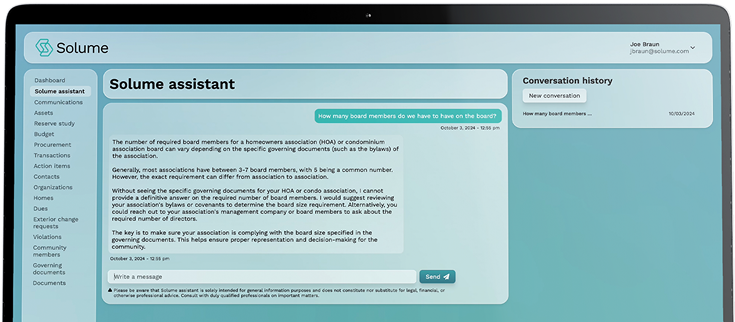
The Insurance Information Institute's guide to condo insurance explains why an HO-6 policy exists at all: the master policy was never designed to insure your possessions. Every owner should read the governing documents to see exactly where the boundary sits. If questions come up about interpreting those provisions, Solume's AI Assistant for governing document and compliance questions can help boards and owners find clear answers quickly. That single line determines thousands of dollars of exposure after a loss.
Who pays for condo association insurance?
Nobody writes a personal check for the master policy directly. The premium is a shared expense, folded into the association's operating budget and funded through condo association dues. Owners pay their share every month without always seeing the line item.
The split is rarely equal. Most governing documents divide the premium by each unit's percentage of common interest, usually tied to square footage relative to the whole building. A larger penthouse unit carries a bigger slice of the condo association insurance cost than a small studio. This is set in the declaration, not something the board improvises year to year.
Here's why it matters. When premiums jump, so do dues, and boards often absorb the increase quietly rather than explain it. That erodes trust. Communities that track insurance costs against the rest of the budget can show owners exactly where the money goes. Solume's financial management tools for your association let self-managed boards break down the premium across the budget and report it transparently, so owners understand what their dues fund.

Cost of condo association insurance and factors affecting price
Condo association insurance cost swings wildly depending on the building. A small, low-rise community might pay around $3,500 a year for the master policy. A large high-rise with elevators, underground parking, and a pool can run past $100,000. Townhouse association insurance often lands cheaper than a stacked high-rise because there's less shared structure and vertical risk.
Several factors drive the number. Building age and construction type matter, since older wiring and plumbing raise fire and water claim risk. Location plays a huge role. Buildings in Florida hurricane zones or California wildfire regions face steep premiums. Coastal communities should also factor in FEMA's National Flood Insurance Program, since standard master policies typically exclude flood damage entirely. Claims history counts too. A building that files claims repeatedly will see rates climb.
The root cause of recent premium spikes is the reinsurance market. When insurers that back the primary carriers raise their own rates after major catastrophe years, that cost flows straight down to community associations, driving up the condo association insurance cost. In hard markets, the only levers are often raising the deductible or accepting lower insurance policy coverage limits. Both shift risk back onto owners. Consider a self-managed board that inherited a policy last renewed at pre-hurricane rates: they open the renewal notice to a 40% premium jump, no reserve cushion to absorb it, and a special assessment vote scheduled for the next meeting. Carefully building an HOA budget that accounts for insurance premiums helps boards plan for these swings before they become emergencies.
Common purchasing mistakes and coverage gaps
The most expensive purchasing mistakes come from boards treating insurance as a renewal formality. Here's the hard truth: nobody reads the policy until a claim forces them to.
The classic coverage gap sits between the master policy deductible and owners' HO-6 policies. A building with a $50,000 wind deductible means the first $50,000 of any storm claim isn't paid by the master policy. If the governing documents allow it, that cost gets passed to owners as a special assessment. Owners who never bought loss assessment coverage on their HO-6 policy eat that bill directly.
Underinsuring the building is another frequent error. If the master policy insures the structure for less than the true replacement cost, a total loss leaves the association short, and the gap becomes a special assessment split across every unit. This happens because most policies pay out only up to the stated limit, so a building insured at 70% of replacement cost leaves owners covering the other 30% themselves. Boards also skip adequate liability coverage, which invites problems when lawsuits follow an injury in the common areas.
The fix isn't complicated: reconcile the master policy language against a standard HO-6 policy, confirm replacement-cost valuations annually, and tell owners in writing where their responsibility begins.
Keeping coverage current and filing a claim
A condo association insurance policy that fit the building five years ago may be badly out of date today. Construction costs have climbed. A master policy that hasn't been re-evaluated for replacement cost can leave the community underinsured without anyone realizing it. Board members should schedule an annual review with the broker and update valuations before renewal, not after a loss.
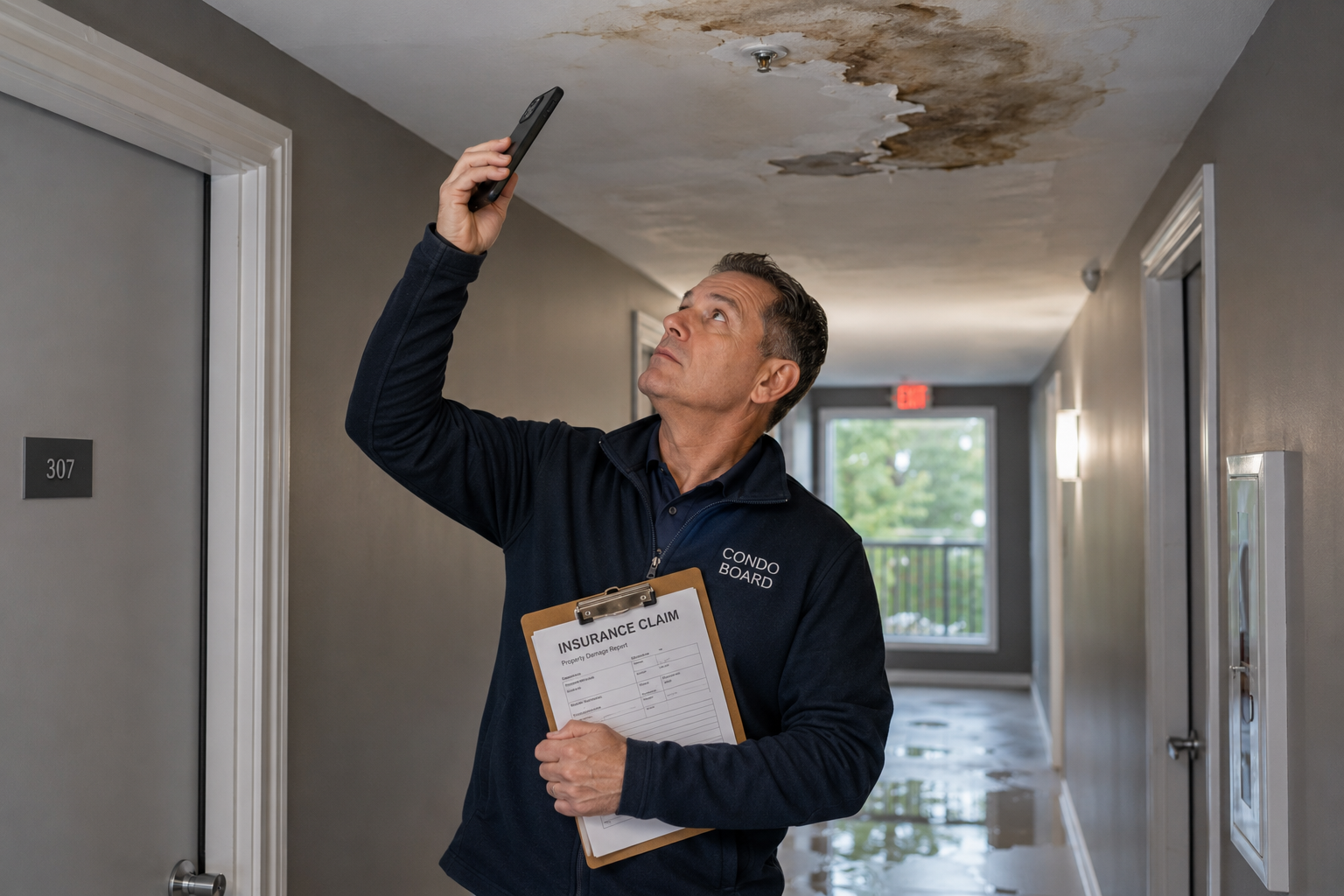
Filing a claim is where disorganized boards lose money. When a pipe bursts or a storm hits, the association needs the declarations page, coverage limits, deductibles, and prior claim records within hours, not days. Delays in reporting can jeopardize the payout entirely, since most policies require prompt notice as a condition of coverage.
Here's why it matters. An insurance claim on the master policy affects every owner, so the process has to be documented and consistent. Photograph damage immediately, notify the carrier the same day, and keep a written log of every conversation. When the claim overlaps with unit interiors, coordinate with affected owners' HO-6 carriers early, so the two policies don't stall each other while responsibility gets sorted out.
How insurance ties into reserve planning and financial responsibility
Insurance and reserve planning are two halves of the same problem: what happens when something expensive breaks. Insurance handles sudden, accidental loss. Reserves handle predictable wear and eventual replacement. A board that funds one but ignores the other still ends up hitting owners with special assessments.
The connection shows up at the deductible. A master policy with a high wind or water deductible only makes sense if the reserve fund can absorb that deductible without triggering an emergency assessment. Boards that carry a $50,000 deductible with a $10,000 reserve balance are one storm away from a crisis. Strong reserve planning turns a manageable claim into a non-event instead of a financial shock.
The Champlain Towers South collapse in Surfside, Florida, which killed 98 people, is the extreme example of what deferred financial responsibility can lead to. It reshaped reserve law across the country. Solume's automated reserve study tools help self-managed communities model these funding scenarios and coordinate reserve targets with the master policy deductible. You can see how the two connect on our reserve study resources.
State-specific insurance and compliance considerations for condo boards
Condo association insurance requirements aren't uniform. They shift by state, and compliance is not optional. Florida's structural reserve rules, tightened after Surfside, now require milestone inspections and structural integrity reserve studies for many condo buildings under the state's condominium statutes. Boards operating in that state should review Florida's condo reserve study requirements to understand how they interact with insurance obligations. Those rules directly affect how boards budget alongside insurance. California, Nevada, and other states impose their own reserve and disclosure requirements under their respective statutes.
Many governing documents also set minimum coverage floors. Lenders financing units often demand specific master policy limits before they'll approve a mortgage. A board that lets coverage drop below the mortgage-required threshold can accidentally make units in the building unsellable, because a buyer can't close on a unit the lender won't finance.
Here's where boards need to be careful. Insurance and reserve statutes vary by state, so confirm your obligations against your state's condominium act and reserve statutes rather than assuming a neighbor's rules apply. For interpretation of how those statutes apply to your specific situation, boards should consult a licensed attorney in their state rather than relying on general information. Getting compliance wrong doesn't just risk a fine. It exposes board members personally when a D&O coverage dispute or lawsuits follow. Directors and officers insurance exists precisely because compliance decisions carry personal liability.
How self-managed boards should track and organize insurance documents
Self-managed communities live and die by their recordkeeping. Without a management company holding the file cabinet, the job of tracking every policy, renewal date, and claim record falls on volunteer board members who already have day jobs. Boards weighing whether to hire outside help should also know the red flags to watch for with management companies before handing over those responsibilities.
The risk most boards overlook is turnover. When a treasurer steps down, the master policy details, broker contacts, and claim history often walk out the door with them. The next board rebuilds from scratch, sometimes missing a renewal or losing track of the current coverage limits entirely. That gap is exactly how a community ends up with a lapsed policy nobody noticed until a claim gets denied.
A workable system keeps the declarations page, full policy, endorsements, broker contact, and every prior insurance claim in one shared, permanent location that survives transitions. It should flag renewal dates well in advance, so coverage never lapses. For community associations and homeowners association boards without dedicated staff, a centralized platform beats a personal email inbox every time. Solume centralizes member records, vendor references, and association property documents in one place, so a change in board leadership doesn't reset the community's institutional memory or its condo association insurance coverage records.
If your board wants a clearer way to manage finances, reserve planning, and the documents behind your association property and condo association insurance coverage, you can book a 15-minute call to see if Solume fits your community. No pressure, just a straight look at whether it solves the problems you're actually dealing with.
Frequently Asked Questions
What does a condo association's master insurance policy actually cover?
A master policy covers the building's structure and shared spaces like the roof, exterior walls, hallways, elevators, lobbies, parking structures, and amenities such as pools or gyms. It also provides general liability protection for injuries or property damage that happen in those common areas.
How is condo association insurance different from the insurance an individual owner buys?
The association's master policy protects shared property and common areas, while an individual owner's HO-6 policy covers the inside of their unit, personal belongings, and personal liability. Where the master policy stops and the owner's policy begins depends on whether the association carries bare walls or all-in coverage.
What's the difference between bare walls and all-in coverage?
Bare walls coverage insures only the structural elements and common areas, leaving unit interiors like flooring, cabinets, appliances, and fixtures to the owner's HO-6 policy. All-in (also called single-entity) coverage extends into the unit interiors, which reduces what individual owners are responsible for insuring.
Who actually pays for the association's insurance?
Unit owners fund the master policy collectively through their regular dues or assessments. Premiums are typically divided by each unit's percentage of common interest, usually based on square footage relative to the whole building as outlined in the governing documents.
Is condo insurance an HO-3 or HO-6 policy?
Individual condo owners carry an HO-6 policy, which covers unit interiors, personal property, and personal liability. HO-3 is a standard homeowners policy for single-family homes and doesn't fit the condo ownership structure, where the association separately insures the building shell.
Is it worth reviewing the master policy if the association already has coverage?
Yes, because the biggest financial risk is a coverage gap between the master policy and owners' HO-6 policies, which surfaces only after a claim is filed. Boards should confirm whether coverage is bare walls or all-in and communicate it clearly, so owners aren't left paying out of pocket for interior damage they assumed was covered.
What happens if the master policy doesn't cover enough after a major loss?
If a claim exceeds the policy limits or hits a large deductible, the shortfall often becomes a special assessment split among all owners. Underinsured buildings and high deductibles are a common reason boards face surprise assessments after fires, storms, or water damage in common areas.