
Every spring, a treasurer somewhere gets the same email from a homeowner: "Can I deduct my HOA dues?" The honest answer disappoints most of them. So are HOA fees tax deductible? For the average person living in their own home, no. Assuming otherwise can cost you an amended return and a conversation with the IRS you'd rather not have. But the rule flips depending on how you use the property. This article walks through when your dues stay a personal expense and when they legitimately become a tax deduction.
Disclaimer: This article is intended for informational purposes only and does not constitute tax, legal, or financial advice. Always consult a certified tax professional or CPA regarding your specific situation.
Key Takeaways
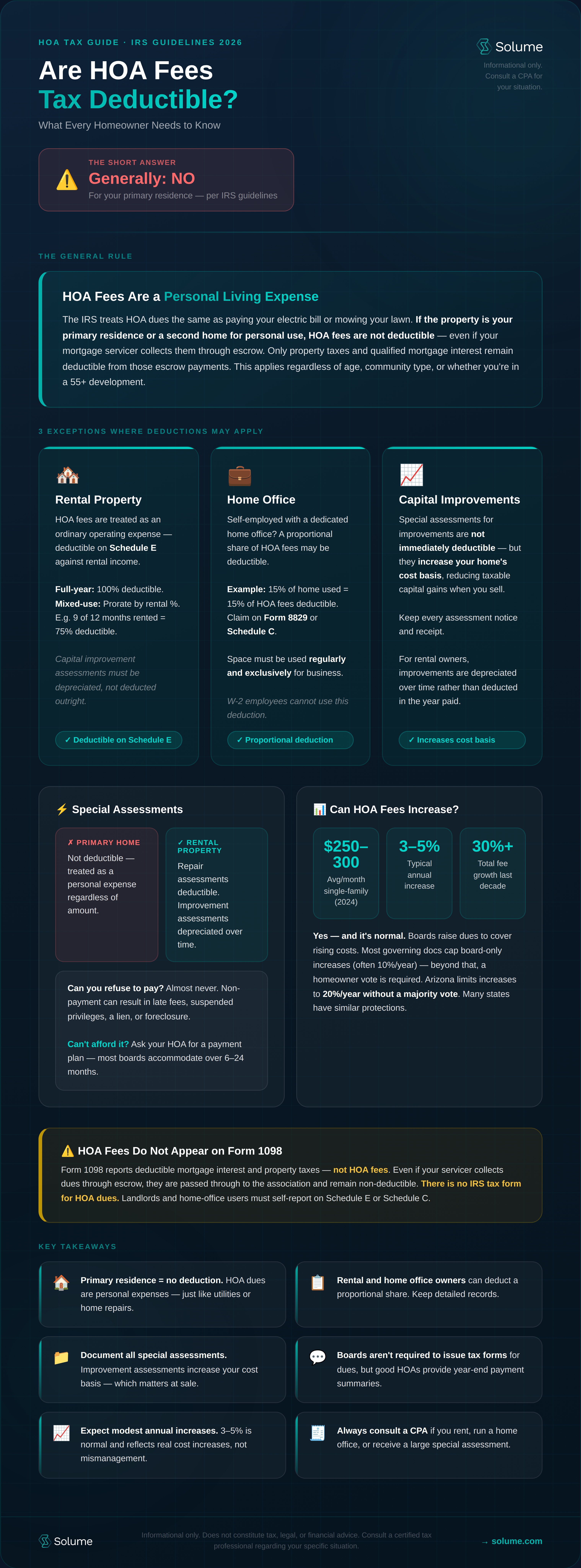
- HOA fees are generally not tax deductible on a primary residence because the IRS classifies them as personal living expenses.
- Owners of rental properties can deduct HOA fees as an operating expense on Schedule E against their rental income.
- Self-employed people with a qualifying home office can deduct the business-use percentage of their HOA fees, but W-2 remote employees cannot.
- Special assessments for repairs are usually deductible in the year paid, while assessments for improvements must be capitalized and depreciated.
- Accurate dues and assessment records are essential to support any HOA-related deduction, since neither your board nor your management software provides tax advice.
What Are HOA Fees and What Do They Cover?
Homeowners association fees are the recurring payments members make to fund the shared operation of their community. If you live in a planned development, a condo building, or a gated neighborhood, your HOA dues pay for the things no single owner controls alone. That includes landscaping, private road maintenance, insurance on common areas, amenity upkeep, and the community's reserve fund for future capital repairs.
The amount varies widely. A small self-managed HOA might charge $150 a month, while a high-amenity condo association fee can top $1,000. Part of every payment ideally goes into a reserve fund. That fund exists to cover large, predictable expenses like roof replacement or repaving without a surprise bill later. If you're on a smaller board, sound bookkeeping practices for small HOAs help you allocate those payments cleanly between operating costs and reserves.
Understanding what your dues fund matters at tax time. The IRS cares about the *nature* of the expense, not the label. IRS Publication 530, which covers tax information for homeowners, spells out which housing costs are deductible and which are not. Under these IRS rules, homeowners association fees sit in the nondeductible category for most owners. Knowing that up front saves you from bad assumptions.
The General Rule: HOA Fees Are Not Deductible for a Primary Residence
Here's the hard truth: if the home is where you live, your HOA fees are generally treated as a personal expense. The IRS treats them the same way it treats your electric bill or your homeowners insurance premium. There's no line on Form 1040 to write off HOA fees on a primary residence, and no itemized deduction covers them.
This trips people up because two other housing costs *are* deductible when you itemize. The mortgage interest deduction and the deduction for property taxes both appear on Schedule A. Many assume HOA dues ride along with those. In reality, dues go to a private association, not a government or a lender, so they don't qualify. For a fuller picture of eligible housing costs, the IRS Publication 530 for homeowners breaks down exactly what does and doesn't count.
The reason comes down to how the tax code defines deductible expenses. To write off an expense, it generally has to be tied to producing income or running a business. Living in your own home produces neither. The IRS overview of deductible and nondeductible expenses reinforces this: personal costs stay personal. So for your primary residence, the answer to "are HOA fees tax deductible" is generally no.

Federal vs. State Tax Treatment of HOA Fees
The federal treatment is the headline, but your state return can behave differently. This is where boards and homeowners get confused. For federal income taxes, the rules above apply everywhere. HOA fees on a primary residence are generally not deductible, and the exceptions for rentals and home offices are federal exceptions.
State income taxes are their own animal. Most states with an income tax start from your federal figures. So if the fees aren't deductible under federal income taxes, they usually aren't deductible at the state level either. A handful of states offer property-related credits or deductions that don't exist federally, but these almost never target HOA dues.
Some states have no state income tax at all, which makes the whole state question moot for residents there. If you live in a state that regulates HOAs heavily, such as California, Florida, or Nevada, the tax treatment of HOA fees still tracks the federal approach. Those states just regulate HOAs aggressively on the operational side. Because details vary, confirm your situation with your state's tax authority or a qualified tax professional before you claim anything.

When HOA Fees Are Deductible: Rental and Investment Properties
Turn that same condo into a rental and everything changes. When a property generates rental income, the IRS generally treats it as a business activity. HOA fees then become an ordinary and necessary business expense. That means you can generally write off HOA fees against the rent you collect. The IRS Publication 527 on residential rental property lays out which rental expenses qualify and how to report them.
For a full-time rental property or investment property, you generally deduct the entire annual amount. It doesn't matter whether it's called HOA dues, condo association fees, or a monthly maintenance charge. You report it on Schedule E, where rental income and its deductible expenses live on your federal return.
The mechanism is simple. Dues you pay to keep a rental habitable and marketable directly reduce your taxable rental profit. A $4,800 yearly HOA bill on a rented unit can generally offset $4,800 of your rental income. That's why the answer to "are HOA fees tax deductible" often flips from no to yes the moment the property earns rent: the expense is now tied to producing income. Understanding how HOA dues are collected and tracked makes it far easier to produce the records that back up a deduction like this.
One scenario is worth remembering. A small-portfolio landlord we've talked to owned two condos in the same building. He lived in one and rented the other. He deducted HOA fees on both for three years before an accountant caught it. Only the rented unit qualified, and he owed back taxes plus interest on the disallowed half. The split matters.
Home Office Deduction: Deducting a Portion of HOA Fees
If you run a business from home, part of your HOA fees may come off your taxes. But the qualifying bar is strict. The home office deduction requires that a portion of your home be used *exclusively and regularly* for business. A kitchen table you also eat dinner at doesn't count. The IRS home office deduction guidelines explain the exclusive-use test in detail.
When you qualify, the deduction is proportional. If your dedicated office takes up 10% of your home's square footage, you can generally deduct 10% of your HOA dues as a business expense. You'd claim it on Schedule C as part of your home office costs, alongside a share of utilities and insurance. For the full mechanics, see IRS Tax Topic 509 on business use of home.
Here's the catch that surprises a lot of remote workers. Many assume that working from home earns them the home office deduction. In reality, W-2 employees generally lost that ability under the Tax Cuts and Jobs Act, which suspended unreimbursed employee expenses through the 2026 tax year. So if you're a salaried employee working from home, you generally cannot deduct any portion of your HOA fees, no matter how many hours you log at your desk. The home office deduction for HOA fees generally belongs to the self-employed.
Part-Time or Vacation Rentals and Second Homes
A second home or vacation home you use only for yourself generally follows the primary-residence rule. The HOA fees are treated as a personal expense and are generally not deductible. Owning a second home you don't rent doesn't create a business, so there's generally nothing to write off.
Mix personal and rental use and you enter proration territory. If you rent your vacation home for part of the year and use it yourself the rest, you can generally deduct HOA fees only for the days the property was rented or genuinely available for rent. The personal-use portion generally stays nondeductible.
The math is a ratio. Rent the home 120 days out of 365 and roughly a third of your annual HOA dues may become a deductible expense on Schedule E. Keep a clean calendar of rental days versus personal days, because that log is what supports the split if the IRS asks. What many owners don't realize is that even a few weeks of personal stays can shrink the deductible share of an investment property. Track usage the way you'd track any other business record.

HOA Fees, Special Assessments, and Capital Gains When You Sell
Special assessments deserve their own attention because they don't always behave like regular dues. When your HOA hits members with a one-time charge, the tax treatment depends on what the money pays for.
On a rental property, a special assessment for a repair that restores existing property generally counts as deductible. Think patching a damaged roof or fixing a broken elevator. That cost is generally deductible in the year you pay it. A special assessment for an improvement, such as building a new clubhouse or adding covered parking, is different. Under IRS rules that cost generally must be capitalized and depreciated over time rather than deducted all at once.
For your primary residence, special assessments generally aren't deductible, but improvement-related ones can still help you. They generally add to your cost basis, the figure used to calculate profit when you sell. A higher cost basis means lower capital gains taxes down the road.
Here's why cost basis matters. If you paid $300,000 for a condo and later covered a $15,000 special assessment for a structural upgrade, your basis generally rises to $315,000. That trims the capital gains taxes owed at sale. Repair assessments on a personal residence generally don't add to basis. Keep every assessment notice, because reconstructing this at closing is a nightmare. Good financial management tools for HOAs make it far easier to keep those assessment records straight from the board's side.
Where and How to Report HOA Fees on Your Taxes
Knowing how to deduct HOA fees comes down to using the right form for the right situation. Get the form wrong, and the deduction may get disallowed even when you technically qualified.
- Rental property: Report HOA fees as an operating expense on Schedule E, where they offset rental income. This is the most common way owners legitimately write off HOA fees.
- Home office (self-employed): Deduct the business-use percentage on Schedule C as part of your home office costs.
- Primary residence: There's generally nowhere to report them. They're a personal expense and stay off your return entirely.
- Improvement special assessments: Track these separately to adjust your cost basis when you eventually sell.
The recordkeeping rule is the same across all of these: save your HOA billing statements, annual dues summaries, and assessment notices. If you claim a partial deduction, document the ratio. That means square footage for a home office or rental days for a part-time rental. During tax season, that paper trail is the difference between deductible expenses that hold up and ones you can't defend.
HOA Fees for 55+ and Retirement Communities
Living in a 55+ community or one of the many age-restricted retirement communities doesn't change the tax rules, even though the dues can be steep. These communities often carry higher HOA fees because they bundle in amenities like clubhouses, transportation, and extensive grounds maintenance.
Higher dues, unfortunately, don't create a deduction. If the home is your primary residence, those HOA fees are generally a personal expense, exactly like they'd be in any other neighborhood. Being retired or over 55 doesn't unlock a special write-off for association dues.
The one place the rules apply the same way is with rentals. If a retiree rents out a unit in a 55+ community as an investment property, the HOA fees generally become deductible against that rental income on Schedule E. Some retirees also run a genuine home-based business and may qualify to claim a portion of their dues as a business expense. The activity determines deductibility, not the community's age designation. Retirees on fixed incomes should still plan for special assessments, since underfunded reserve funds hit this group especially hard. Getting ahead of that starts with building an HOA budget that funds reserves realistically year over year.
What Boards Should Report to Homeowners at Tax Season
Boards can't give tax advice, but they can hand owners the records that make deductions provable. For self-managed HOA boards, this is a core part of financial responsibility and transparency. It's also where a lot of volunteer boards fall short.
At minimum, give homeowners access to:
1. Annual dues statements showing what each owner paid over the year.
2. A breakdown of any special assessments, clearly labeled as repair or improvement, since that distinction drives the tax treatment.
3. Reserve fund contributions and balances, which support financial transparency and help owners understand where their money goes.
The board responsibilities here stop at accurate reporting. You provide numbers; owners take them to their tax professional. When records are sloppy, owners can't substantiate legitimate deductions and the board fields angry calls all through tax season. These board responsibilities, done well, protect everyone and reinforce community stability. Boards should also understand their own filing obligations, since most associations file Form 1120-H for homeowners associations at the entity level. For deeper guidance, our more HOA accounting resources walk through the reporting side in detail.
If your board wants a clearer way to produce accurate dues records, track special assessments, and keep reserve planning organized, you can see how it works with a 15-minute call and find out whether Solume is a good fit for your community. It's built for self-managed boards that want financial transparency without hiring a management company.
Frequently Asked Questions
Are HOA fees tax deductible on your primary residence?
No. The IRS treats HOA fees for a personal residence as nondeductible living expenses, similar to utilities or homeowners insurance. There is no line on your personal return to write them off.
When do HOA fees actually become deductible?
HOA fees are deductible when the property is a rental or when part of your home is used exclusively for a qualifying business. In both cases, the fees are treated as ordinary and necessary property expenses rather than personal costs.
How do I deduct HOA fees on a rental property?
You report them as an operating expense on Schedule E of your federal return, where they offset your rental income. For a full-time rental, the entire annual HOA fee is generally deductible.
Can I write off part of my HOA fees if I work from home?
Only if you're self-employed and use a portion of your home exclusively and regularly for business. If your office takes up 10% of your home's square footage, you can generally deduct 10% of your HOA fees; W-2 employees cannot deduct these under the Tax Cuts and Jobs Act.
Are HOA special assessments treated the same as regular dues for taxes?
Not always. On a rental, an assessment for repairs that restore the property (like fixing a damaged roof) is usually deductible in the year paid, while an assessment for improvements typically must be capitalized and depreciated over time.
Is it worth tracking HOA fees for a small business or partial rental?
Yes, because the deduction scales with your business-use or rental percentage and adds up over a full year. Keep your HOA billing statements and a record of your square footage or rental-use ratio to support the amount you claim.
What if I only rent out my property for part of the year?
You can generally deduct HOA fees only for the portion of the year the home was rented or available for rent. Fees tied to your personal-use period remain nondeductible, so you'll need to prorate the annual amount.